Thursday, April 24, 2014

Week of April 24

Thursday Thoughts April 24


I must admit that I too have jumped on the "Happy" song bandwagon by Pharrell Williams.  Maybe it is because I have been a Pharrell Williams fan for well over a decade or maybe it is because he has written a song that crosses all lines and makes everybody feel good.  Not only is the hook "catchy" but the lyrics really speak to me.  "Here come bad news talking this and that, yeah, Well, give me all you got, and don’t hold it back, yeah, Well, I should probably warn you I’ll be just fine, yeah, No offense to you, don’t waste your time.....because I'm happy."
 
For me, the song doesn't really represent a feeling but more of an attitude.  Being happy or having a positive attitude is a choice.  This choice is easy to make when everything is going well.  The challenge is to remain positive when things are falling apart.  If you aren't happy, do something about it...make a change....surround yourself with others who are happy.....laugh more.  You will find that a positive attitude and doing the little things that make you happy will truly make a difference in your daily life.   Here's the link to the video in case you need to laugh right now and want to dance around and be happy.


Staff Spotlight

This week I would like to shine the spotlight on Sue Bates and Rachel Rafinski.  Early in the year I approached them about participating in the Fulton County STEM Academy.  They accepted the challenge and were among 30 other teachers in the NELC who participated in the yearlong program.  The program highlighted best practices, introduced the STEM framework and gave them an opportunity to collaborate with other teachers to create new lessons. With all of the changes that we endured this school year, I know it was a sacrifice on their part to participate.  Because of the work they have done this year, we will be ready to jump right into a "STEMY" (get it) school year in August.  Sue and Rachel, thank you for not only making your students a priority, but also your willingness to further your professional knowledge and share it with others.  We can't wait to move full "STEM" ahead. 


4C's: Collaboration, Communication, Creativity, Critical Thinking Skills

27 Ways to Inspire Students to Innovate

 
Educator Mia MacMeekin made this infographic about ways to inspire students to think more deeply about how innovation applies to them. It’s a helpful way to begin a conversation about what it means to innovate, a word that sometimes seems to belong in the adult domain of business and is estranged from how students think about living their lives.
rethinkinginnovation
Maria L. MacMeekin


Technology Tidbits: (If you have websites to share please email me and I will share with all)

Check out the following website:


http://www.mathwire.com/problemsolving/probs.html- problem solving resources for grades K-8

News & Notes:

The proposed technology camp, "Lights, Camera, Action" for rising 5th grade MBES students has been approved!  The camp will be held the week of June 23rd from 9am-12pm. Sign up flyers will be sent home soon.  We still need one additional teacher.  If you enjoy teaching students how to create various tech projects, please see me by May 2nd.  The camp will be free of charge and any current 4th grade student will be eligible to attend.  In addition, the Media Center will be open for several dates again this summer.  Leigh will get that information out to students and staff toward the end of the year.


Thursday, April 17, 2014

Week of April 17

Thursday Thoughts April 17


In the busyness of this week, I forgot to share with you that Nisha was able to bring the baby home from the hospital on Tuesday.  What a tremendous blessing considering that Nisha's original due date was May 1st.    As long as we live, problems, worries and troubles will arise.  But if we focus on the blessings that we have and remain positive during troubled times, we will get through our experiences.  We will then be able to share those experiences with others so that they might be encouraged to hang in there.

Staff Spotlight

This week I would like to shine the spotlight on Sarah Ley.  Sarah is an active participant of the Reading Workshop Cohort and has embraced the Reader's Workshop wholeheartedly.  She has used it to hep her students make great gains in reading.  Throughout this year, Sarah had some challenges with students and continually worked to meet their needs and help them become successful.  When Sarah felt that she needed additional assistance with a couple of students, she reached out for help. She always comes to SST meetings prepared and willing to implement the ideas and suggestions provided.   Whenever you see Sarah, you will be greeted with a kind word and a smile.
  Sarah- thank you for the work that you are doing at Medlock Bridge.


4C's: Collaboration, Communication, Creativity, Critical Thinking Skills

Twelve Things You Were Not Taught in School About Creative Thinking

By Michael Michalko


1. You are creative.
The artist is not a special person, each one of us is a special kind of artist. Every one of us is born a creative, spontaneous thinker. The only difference between people who are creative and people who are not is a simple belief. Creative people believe they are creative. People who believe they are not creative, are not. Once you have a particular identity and set of beliefs about yourself, you become interested in seeking out the skills needed to express your identity and beliefs. This is why people who believe they are creative become creative. If you believe you are not creative, then there is no need to learn how to become creative and you don't. The reality is that believing you are not creative excuses you from trying or attempting anything new. When someone tells you that they are not creative, you are talking to someone who has no interest and will make no effort to be a creative thinker.
2. Creative thinking is work.
You must have passion and the determination to immerse yourself in the process of creating new and different ideas. Then you must have patience to persevere against all adversity. All creative geniuses work passionately hard and produce incredible numbers of ideas, most of which are bad. In fact, more bad poems were written by the major poets than by minor poets. Thomas Edison created 3000 different ideas for lighting systems before he evaluated them for practicality and profitability. Wolfgang Amadeus Mozart produced more than six hundred pieces of music, including forty-one symphonies and some forty-odd operas and masses, during his short creative life. Rembrandt produced around 650 paintings and 2,000 drawings and Picasso executed more than 20,000 works. Shakespeare wrote 154 sonnets. Some were masterpieces, while others were no better than his contemporaries could have written, and some were simply bad.
3. You must go through the motions of being creative.
When you are producing ideas, you are replenishing neurotransmitters linked to genes that are being turned on and off in response to what your brain is doing, which in turn is responding to challenges. When you go through the motions of trying to come up with new ideas, you are energizing your brain by increasing the number of contacts between neurons. The more times you try to get ideas, the more active your brain becomes and the more creative you become. If you want to become an artist and all you did was paint a picture every day, you will become an artist. You may not become another Vincent Van Gogh, but you will become more of an artist than someone who has never tried.
4. Your brain is not a computer.
Your brain is a dynamic system that evolves its patterns of activity rather than computes them like a computer. It thrives on the creative energy of feedback from experiences real or fictional. You can synthesize experience; literally create it in your own imagination. The human brain cannot tell the difference between an "actual" experience and an experience imagined vividly and in detail. This discovery is what enabled Albert Einstein to create his thought experiments with imaginary scenarios that led to his revolutionary ideas about space and time. One day, for example, he imagined falling in love. Then he imagined meeting the woman he fell in love with two weeks after he fell in love. This led to his theory of acausality. The same process of synthesizing experience allowed Walt Disney to bring his fantasies to life.
5. There is no one right answer.
Reality is ambiguous. Aristotle said it is either A or not-A. It cannot be both. The sky is either blue or not blue. This is black and white thinking as the sky is a billion different shades of blue. A beam of light is either a wave or not a wave (A or not-A). Physicists discovered that light can be either a wave or particle depending on the viewpoint of the observer. The only certainty in life is uncertainty. When trying to get ideas, do not censor or evaluate them as they occur. Nothing kills creativity faster than self-censorship of ideas while generating them. Think of all your ideas as possibilities and generate as many as you can before you decide which ones to select. The world is not black or white. It is grey.
6. Never stop with your first good idea.
Always strive to find a better one and continue until you have one that is still better. In 1862, Phillip Reis demonstrated his invention which could transmit music over the wires. He was days away from improving it into a telephone that could transmit speech. Every communication expert in Germany dissuaded him from making improvements, as they said the telegraph is good enough. No one would buy or use a telephone. Ten years later, Alexander Graham Bell patented the telephone. Spencer Silver developed a new adhesive for 3M that stuck to objects but could easily be lifted off. It was first marketed as a bulletin board adhesive so the boards could be moved easily from place to place. There was no market for it. Silver didn't discard it. One day Arthur Fry, another 3M employee, was singing in the church's choir when his page marker fell out of his hymnal. Fry coated his page markers with Silver's adhesive and discovered the markers stayed in place, yet lifted off without damaging the page. Hence the Post-it Notes were born. Thomas Edison was always trying to spring board from one idea to another in his work. He spring boarded his work from the telephone (sounds transmitted) to the phonograph (sounds recorded) and, finally, to motion pictures (images recorded).
7. Expect the experts to be negative.
The more expert and specialized a person becomes, the more their mindset becomes narrowed and the more fixated they become on confirming what they believe to be absolute. Consequently, when confronted with new and different ideas, their focus will be on conformity. Does it conform with what I know is right? If not, experts will spend all their time showing and explaining why it can't be done and why it can't work. They will not look for ways to make it work or get it done because this might demonstrate that what they regarded as absolute is not absolute at all. This is why when Fred Smith created Federal Express, every delivery expert in the U.S. predicted its certain doom. After all, they said, if this delivery concept was doable, the Post Office or UPS would have done it long ago.
8. Trust your instincts.
Don't allow yourself to get discouraged. Albert Einstein was expelled from school because his attitude had a negative effect on serious students; he failed his university entrance exam and had to attend a trade school for one year before finally being admitted; and was the only one in his graduating class who did not get a teaching position because no professor would recommend him. One professor said Einstein was "the laziest dog" the university ever had. Beethoven's parents were told he was too stupid to be a music composer. Charles Darwin's colleagues called him a fool and what he was doing "fool's experiments" when he worked on his theory of biological evolution. Walt Disney was fired from his first job on a newspaper because "he lacked imagination." Thomas Edison had only two years of formal schooling, was totally deaf in one ear and was hard of hearing in the other, was fired from his first job as a newsboy and later fired from his job as a telegrapher; and still he became the most famous inventor in the history of the U.S.
9. There is no such thing as failure.
Whenever you try to do something and do not succeed, you do not fail. You have learned something that does not work. Always ask "What have I learned about what doesn't work?", "Can this explain something that I didn't set out to explain?", and "What have I discovered that I didn't set out to discover?" Whenever someone tells you that they have never made a mistake, you are talking to someone who has never tried anything new.
10. You do not see things as they are; you see them as you are.
Interpret your own experiences. All experiences are neutral. They have no meaning. You give them meaning by the way you choose to interpret them. If you are a priest, you see evidence of God everywhere. If you are an atheist, you see the absence of God everywhere. IBM observed that no one in the world had a personal computer. IBM interpreted this to mean there was no market. College dropouts, Bill Gates and Steve Jobs, looked at the same absence of personal computers and saw a massive opportunity. Once Thomas Edison was approached by an assistant while working on the filament for the light bulb. The assistant asked Edison why he didn't give up. "After all," he said, "you have failed 5000 times." Edison looked at him and told him that he didn't understand what the assistant meant by failure, because, Edison said, "I have discovered 5000 things that don't work." You construct your own reality by how you choose to interpret your experiences.
11. Always approach a problem on its own terms.
Do not trust your first perspective of a problem as it will be too biased toward your usual way of thinking. Always look at your problem from multiple perspectives. Always remember that genius is finding a perspective no one else has taken. Look for different ways to look at the problem. Write the problem statement several times using different words. Take another role, for example, how would someone else see it, how would Jay Leno, Pablo Picasso, George Patton see it? Draw a picture of the problem, make a model, or mold a sculpture. Take a walk and look for things that metaphorically represent the problem and force connections between those things and the problem (How is a broken store window like my communications problem with my students?) Ask your friends and strangers how they see the problem. Ask a child. How would a ten year old solve it? Ask a grandparent. Imagine you are the problem. When you change the way you look at things, the things you look at change.
12. Learn to think unconventionally.
 Creative geniuses do not think analytically and logically. Conventional, logical, analytical thinkers are exclusive thinkers which means they exclude all information that is not related to the problem. They look for ways to eliminate possibilities. Creative geniuses are inclusive thinkers which mean they look for ways to include everything, including things that are dissimilar and totally unrelated. Generating associations and connections between unrelated or dissimilar subjects is how they provoke different thinking patterns in their brain. These new patterns lead to new connections which give them a different way to focus on the information and different ways to interpret what they are focusing on. This is how original and truly novel ideas are created. Albert Einstein once famously remarked "Imagination is more important than knowledge. For knowledge is limited to all we now know and understand, while imagination embraces the entire world, and all there ever will be to know and understand."
 

Technology Tidbits: (If you have websites to share please email me and I will share with all)

Check out the following website:


http://www.lakeshore.wnyric.org/Page/3492
The Lake Shore Central School District in Angola, NY has a page of Common Core Math word problems for grades 1st-5th.
 
http://www.wcschools.com/education/components/scrapbook/default.php?sectiondetailid=62235
A first grade teacher's webpage that is full of Common Core math resources.

 
News & Notes:
Congratulations to Kristen Bates who has been specially selected by the National Council of Teachers in Mathematics (NCTM) and the National Science Teachers Association (NSTA) to attend the 2014 Mickelson ExxonMobil Teachers Academy at the Hyatt Regency on the Hudson, Jersey City N.J.

Kristen will join 150 third-through fifth-grade teachers from across the nation in Jersey City, NJ on July 20 for this one week-intensive, all-expense paid professional development opportunity.

By applying at www.sendmyteacher.com, teachers from all 50 states have the opportunity to attend the Academy and hone their math and science teaching skills. More than 1,100 teachers applied for the 2014 Academy, and Kristen's commitment to teaching stood out among the rest.
 

Thursday, April 3, 2014

Week of April 3

Thursday Thoughts  April 3


If you are reading this on Thursday night, then you have approximately 18 hours until Spring Break.  If it is Friday then you have less than 8 hours and you are almost there! I hope that no matter your destination, you take the time to rest.  Turn off your brain.  Do something that is worth sharing with others when you return.  We have worked hard and deserve a few days off.  For those of you who will be on the road (or on the sea) I wish you safe travels.  For those that will enjoy the benefits of staying home, I urge you to dive into some great books or movies and make a lasting imprint on the couch. Thank you for taking caring of our students....now take care of yourself!


This week I would like to shine the spotlight on Jennifer Briskin.  This is Jennifer's first year at Medlock but you would never know it.  Jennifer works closely with the special education team as well as the SST Team to provide strategies, help identify students' needs and administer testing.  Her ability to complete testing well ahead of designated timelines is uncanny.  I have had the opportunity to participate in numerous meetings with Jennifer and she is knowledgeable, compassionate and willing to go the extra mile for students. Although Jennifer is not here on a daily basis, she calls Medlock home and has become a valued member of the team.  Thank you Jennifer for all that you do for our students!

4C's: Collaboration, Communication, Creativity, Critical Thinking Skills

A List Of 50+ Teaching Strategies To Jumpstart Your Teacher Brain   

Teachthought Blog


Teaching strategies are among the most important ingredients for highly-effective learning environments.
In addition to literacy strategies, approaches to assessment, and grouping strategies (among many others), knowing the right teaching strategy for the right academic situation may not be a matter of expertise or training, but memory: out of sight, out of mind, yes?
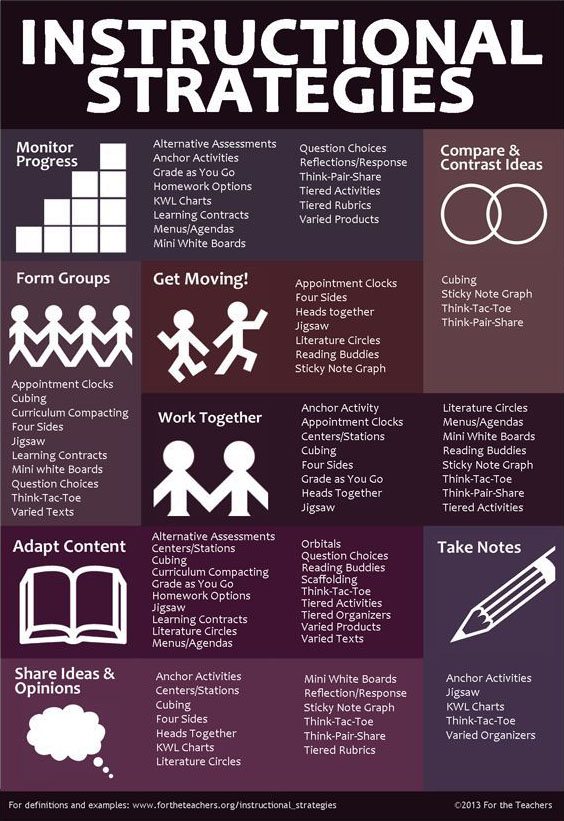
Which makes the following infographic from fortheteachers.org useful.
While it doesn’t offer definitions and explanations for each strategy (it’s an infographic, not a book), and many great strategies are missing (e.g., 3-2-1, exit slip, project-based learning, accountable talk, ask a question, etc.) it does work well as a kind of reminder for what’s possible, even offering categories for each strategy, from progress monitoring (think-pair-share, KWL charts), to Note-Taking (graphic organizers).
There are 87 instructional strategies listed below, but several are repeated across categories, so let’s call it “50+” strategies.
Enjoy!
instructional-strategies-graphic

Technology Tidbits: (If you have websites to share please email me and I will share with all)

Check out the following website:


www.fortheteachers.org This site is a great resource that gives more detail about each of the strategies in the chart above.

News & Notes:

The security buzzer system will be operable within the 3rd week of April.  At that time, I will send a school messenger letter and a hard copy letter home to all parents with the details.

Thursday, March 27, 2014

Week of March 27

Thursday Thoughts March 27


I LOVE student performances!  I just finished watching the kindergarten performance and there is nothing like eighty little ones singing and dancing on a stage with a few hundred parents wrestling each other to get the best view.  I stand to the side and watch with the most ridiculous grin on my face.  Partly because I'm so tire that I'm delirious.  But mostly because I am reminiscing.   I am reminded of a time when my own children were on a stage performing.  I am reminded of a time when they were innocent and loved everything about school.  Life and teenage experiences had not yet jaded them.  The pressure of excelling in academics and sports was not an issue.  When I see these babies on the stage I think about the world in which they will grow up.  I think about ALL of the expectations that their parents have for them.  I think about ALL of the education that is ahead of them. If my math serves me correctly, I just watched the high school class of 2026.  It is my most sincere hope that each of those students is able to retain just a bit of that energy and enthusiasm that they displayed tonight.  As educators we can play a huge role in making sure that happens.


This week I would like to shine the spotlight on Sharon Bradford.  This has been a pretty tough year for Sharon.  I am not sure if it is her proximity to the front door or the nature of what she does (calls parents to give them the "good" news of their sick little ones) but she has had to bear the brunt of some demanding parents this year.  I am always amazed at how she keeps her cool through everything.  There does not seem to be any bodily functions or liquids (or solids) that makes her squeamish.  She is very professional and tries to meet almost all of the requests that are made of her.
Daily life in the clinic is a thankless job and one that can easily be taken for granted.  Yet it is one of the most important jobs here at school.  Just imagine if you had to clean up blood, or other bodily fluids or administer insulin shots.   I am not sure that we could do it so effortlessly.  Sharon we thank you for all that you are doing and have done for Medlock Bridge.

4C's: Collaboration, Communication, Creativity, Critical Thinking Skills

Other Data: 20 Signs You’re Actually Making A Difference As A Teacher

by Saga Briggs, opencolleges.edu.au

You plan. You assess. You network. You collaborate.
You tweet, differentiate, administer literacy probes, scour 504s and IEPs, use technology, and inspire thinking.

And for all of this, you’re given bar graphs on tests to show if what you’re doing is actually making a difference. But there are other data points you should consider as well.

20 Signs You’re Actually Making A Difference As A Teacher

1. Your students are asking questions, not just giving answers.
Critical thinking does not mean thinking harder before giving an answer. It means being critical of all possible answers. If your students are asking more questions, and feel comfortable doing so, you can rest assured they will continue the habit outside your class.
2. You have used your authoritative role for inspiration, not intimidation.
Monkey see, monkey do. I once had a writing professor who, as a best-selling novelist, was not too proud to bring his own raw material to class for the students to workshop. This was a great lesson in humility that I’ll never forget.
3. You have listened as often as you have lectured. Another lesson in authority.
Your students have respected your thoughts and ideas by attending your class; the least you can do is respect theirs. Lending an ear is the ultimate form of empowerment.
4. Your shy students start participating more often without being prompted.
Cold-calling may keep students on their toes, but it never creates an atmosphere of collaboration and respect. When the quiet ones feel comfortable enough to participate on their own, you know you’ve made an impact.
5. A student you’ve encouraged creates something new with her talents.
The simple act of creating is so personal, memorable, and gratifying that you can rest assured your student will want to make it a habit.
6. You’ve been told by a student that, because of something you showed them, they enjoy learning outside of class.
Even if it becomes a short-lived interest, your student will realize that learning outside of class doesn’t have to mean doing homework.
7. You’ve made your students laugh.
People like, and therefore listen to, other people who make them laugh. Showing you have a sense of humor about a topic will lubricate the learning path for your students.
8. You’ve tried new things.
Students, especially if they are older, can be critical of change. A new grading system or an unexpected group discussion session can easily lead to resentment instead of renewed interest. But your students will remember it. Whether the change succeeds or not, they will remember it years down the road when all their other classes, so similar to one another, blur together.
9. You’ve improvised.
Respect and inspiration result from going out on a limb, whether the limb breaks or not.
10. Your student asks you for a letter of reference.
Whether you get bombarded by requests for recommendation letters each year or have been asked for one in your entire career, you can’t deny the confidence you’ve boosted and the difference you’ve made.
11. You have taken a personal interest in your students.
Your favorite student still may not get into college or achieve his career goals—it’s frustrating, but it happens—however, the chances that he will are infinitely higher simply because you showed an interest.
12. You’ve let your passions show through in your lessons.
It’s hard to stay animated when you’ve been teaching the same material for twenty-five years, but it’s also hard for your students to stay animated when they don’t know why your subject should excite them. Even if they never become excited by your subject, they have learned that different people have different interests and that it’s okay to share your passion regardless of what other people think.
13. You’ve made students understand the personal relevance of what they’re learning.
Psychologists have proven time and time again that people remember things much better if they are personally relevant. Perhaps the lone advantage in a self-centered culture.
14. You have cared–and shown that you cared.
Researchers at the University of Leicester have proven that students assign the most authority to teachers who care about them. If this is true, then you are demonstrating a wonderful principle: that respect comes from kind behavior.
15. You have helped a student choose a career.
Whether your student was already interested in your subject when she entered your class or only became interested once you started teaching, you know you’ve done a great thing when she asks you privately about careers in your field.
16. One of your students becomes an educator.
Maybe one of the greatest honors of all. You must know you had some part in the process, whether it was something you did or (yikes) didn’t do.
17. A parent approaches you with kind words.
Certainly too seldom the case, but reassuring when it happens. Sometimes you have no idea your student listened to a word you said until a relative comes forward to thank you.
18. Your students visit you when they don’t have to.
This is not a popularity contest. This is an accessibility contest. If your students feel comfortable approaching you outside of class, whether for help on an assignment or advice on a career, you’ve made a difference already.
19. You can be a mentor when you need to be.
Many students suffer from major obstacles to learning in the form of inner conflict or turmoil at home. While school counselors exist for a reason, you can’t afford to be completely closed off to personal issues. Learning is not independent from feeling, and this is something you can demonstrate to your students.
20. You practice strength and patience.
We’ve all reacted to current situations with emotions left over from the past, whether it’s trouble at home or personal strife. The ultimate lesson, at the end of a rough day, is not blaming anyone but yourself for your reactions. Students are always watching; someday someone will be watching them too.
Despite what administrators might drill into our skulls, educators exist to produce good people, not good test results. The true measure of our success is hard to record on paper but easy to recognize in a student’s behavior. Look for the signs and be open to improvement.

Technology Tidbits: (If you have websites to share please email me and I will share with all)

Check out the following website:


www.mathnook.com Interactive Common Core aligned math games for grades K-5.

News & Notes:

For this upcoming school year, 2014-15, bell times would be as follows: 
 Elementary Schools                        7:40 a.m. – 2:20 p.m.
High Schools                                      8:20 a.m. – 3:30 p.m.
Middle Schools                                 8:55 a.m. -  4:05 p.m.


Thursday, March 20, 2014

Week of March 20

Thursday Thoughts March 20


I don't know about you, but for the last month I feel like I have been on a treadmill and the off switch is broken.  It seems like I am running full speed but going nowhere fast.   It is amazing how your body will force you to slow down and there is absolutely nothing you can do about it.  It is in those times that you actually realize that you are not a robot, but a person, who gets tired and must take a break.  It is also in those times that you remember your purpose.  I want to take a moment to remind you (and myself) that we are in the business of kids.  Yes we have important deadlines to keep, emails to return within 24 hours and tasks that are imposed upon us by external forces.  But we have students to teach, minds to reach and colleagues to support.  We are not here to push papers.  We are here to touch lives.  Now of course we have the job demands that we can't ignore (please don't stage a boycott against the progress reports that are due).  But we have to to remember that our interaction with people is what matters most. Period.
 
Staff Spotlight
This week I would like to shine the spotlight on Mary Beth Eby.  Most of the teachers on staff don't get the pleasure of working with Mary Beth as she primarily works with the little ones.  But those teachers that do have the opportunity would agree that Mary Beth is a true professional.  She not only provides the OT services that our students need, but she is a resource for the teachers that work closely with her.  On many occasions I have watched her assist with a little one that may not be complying with the teacher or a little one who needs to get to the sensory room immediately.  Mary Beth is quiet and goes about the business of helping children without much fanfare.  On a personal note, after raising her own children, Mary Beth and her husband decided to become foster parents and have recently become the proud parents of a seven year old little boy.   She is a valued member of the Medlock Team.  Mary Beth we thank you for all that you do!
  
  
4C's: Collaboration, Communication, Creativity, Critical Thinking Skills

26 Sentence Stems For Higher-Level Conversation In The Classroom

3/12/14 Teach Thought Blog

Meaningful conversation can make learning more personal, immediate, and emotional.
During meaningful conversations, students are forced to be accountable for their positions, to listen, to analyze opposing perspectives, and to adapt their thinking on the fly.
There are many popular strategies for these kinds of conversations, each with slightly unique rules and applications. Among them are Socrative Discussions, Accountable Talks, Debate, and Literature Circles. Whichever strategy you employ, students need support.
It is sometimes argued that the these kinds of conversations favor students that are confident expressing themselves verbally, and that’s hard to argue. But consider that academic writing favors gifted writers, traditional tests favor those comfortable with proving what they know, learning through technology favors students with a more diverse history of using technology, and so on.
And all can benefit from scaffolding, so that students are given different levels of support–maybe unique tiers of index cards with easier to use or more natural stems–so that they can be successful on some level.

If you have any useful conversation stems, let us know in the comments so we can update the list!
26 Sentence Stems For Meaningful Conversation In The Classroom
Clarifying
Could you give me your thesis in one sentence?
Is it your position that…
To be clear, you’re saying that…
I’m confused when you say Z, Can you elaborate?
Paraphrasing
Put another way, you’re saying…
So you’re saying that…
Is it fair to say that you believe…
I hear you saying that…
Agreeing
I agree with Y because…
Z’s point about X was important because…
The evidence for Z is overwhelming when you consider that…
X and I are coming from the same position.
Despite disagreeing about Y, I agree with Z that…
Disagreeing
I see it differently because…
The evidence I’ve seen suggests something different.
Some of that is fact, but some of it is opinion as well.
I agree that Y, but we also have to consider that…
We see Z differently.
Building On
Y mentioned that…
Yes–and furthermore…
The author’s claim that Z is interesting because…
Adding to what X said,…
If we change Xs position just a little, we can see that…
Summarizing
Overall, what I’m trying to say is…
My whole point in one sentence is…
More than anything else, I believe that…

Technology Tidbits: (If you have websites to share please email me and I will share with all)

Check out the following website:


www.masteryconnect.com
MasteryConnect makes it simple to share and discover common assessments and resources,
track mastery of standards, and collaborate.  You can join for free and have access to Common Core assessment questions that have been created by teachers all over the country.  For a subscription you have access to thousands more questions.  May be a good resource for math but has questions for all subjects.

News & Notes:

Please check out the FCS School Psychology Newsletter.   There is an article about a quick research-based strategy that can be taught to students to reduce their stress and test anxiety for the CRCTs http://fcspsychservices.uberflip.com/i/261925  Many thanks to Jennifer Briskin for sharing!

Thursday, March 13, 2014

Week of March 13

Thursday Thoughts March 13
  
I find that in education, especially at the elementary level, great emphasis is placed on being "liked".  Now don't get me wrong, it feels good when people hold you in high regard or when someone compliments you on a job well done.  But we have to be careful that we don't fall prey to the need to try to convince everyone to "like" us.  Face it, there are people in this world that we will not be able to please.  Many times it has nothing to do with us but more to do with them.  Sometimes we find ourselves trying so hard to please people, that we lose sight of who we are and what we stand for.  Think about this....if your words and actions are such that people know you are genuine, honest and have good intentions, you will be respected.  To be liked is based on someone's opinion of you.  To be respected is based on your actions and your attitude. 
  
Staff Spotlight
This week I would like to shine the spotlight on the Keith, Zollman and Smith team.  As a co- teaching team, they have mastered the art of collaborating and communicating.  Co teaching with one other person can often be a challenge but Mr.Smith co teaches with both Mrs. Keith and Mrs. Zollman throughout the day.  Staff from other schools have come to Medlock to observe them and talk to them about how to best manage co teaching.  One of the comments that has been made is "They have a flow that just seems natural."   They work to ensure that all students are using technology and thinking critically regardless of the academic level of the students.  Our students benefit greatly from the co teaching model that is used in 5th grade.  Many thanks to Kristin, Joe and Judy for the work that they are with our students. 

4C's: Collaboration, Communication, Creativity, Critical Thinking Skills

Technology and Teaching: Finding a Balance


by Andrew Marcinek

There is no doubt that finding the time to integrate technology is an overwhelming task for anyone. Throughout the course of a day, teachers find themselves pulled in many directions. However, technology is already integrated in nearly everything we do and nearly every job our students will encounter. So how do educators find an ideal balance for learning about and eventually integrating technology? It begins with a focus followed by good instructional design -- but ultimately, a healthy balance.

Tomorrow's Literacy

Technology is a literacy that is expected in higher education and in our economy. (1) It is a universal language spoken by the entire world, regardless of the profession. Our current students will encounter one of the toughest job markets in generations. Gone are the days of falling into a profession and riding that wave for 30-plus years. However, it's not to say those jobs aren't still available. They are, but they're dwindling as automation and outsourcing continue to expand.
The contemporary job market requires us to adapt, continually learn, and apply various skill sets in many directions. (2) We have to multitask, connect beyond the workday, and collaborate and connect both locally and globally. And while I am promoting that exposure to technology and digital tools is essential, we must do so responsibly. Teaching students how to balance technology usage along with offline socializing and interpersonal skills is essential. But it's irresponsible to proclaim that technology simply distracts, diminishes social skills, and holds lesser value than other content areas. And to do so not only lets our students down, but also negates the mission statements emblazoned on the walls of our schools.
It's equally important to expose students to information literacy skill sets. As databases grow and information continues to evolve into paperless formats, it is essential to teach students how to question effectively and efficiently. In a world flooded with information to read, libraries have never been more important. Along with digital and information literacy skill sets, it's still vital that we promote and encourage a love of reading across all formats -- along with a facility for questioning, analyzing, discerning and synthesizing with other media.

3 Examples of Balanced Tech Integration

Integrating technology doesn't have to consume your life as an educator. In fact, if a little time is spent on, say, Google Drive, teachers can eventually save time and paper, while collaborating more effectively with students. Personally, in my previous classrooms, I didn’t seek to integrate every free Web tool that Richard Byrne (3) posted. However, I simply used his site (and many others) as a resource. I referenced that resource at the beginning of each new semester and made decisions based on what I was teaching. Ultimately I focused on the underlying learning objectives that I wanted, complete with students, and found digital tools to compliment or enhance those skills.
Here are some examples:

Edmodo

If I wanted to introduce my students to collaborative learning spaces or integrate a scaled-down learning management system (LMS), I would use Edmodo (4). I'd research examples of how other teachers were using this tool by simply performing a search for "Edmodo in the classroom." This would present me with a baseline for how other teachers were using this tool. Another option is to ask on Twitter how teachers are leveraging this app in their classrooms.

Google Sites

Another tool I have used and shared with teachers as a digital portfolio system is Google Sites (5). Again, I recommend performing a search for "Google Sites digital portfolio." What you'll find is a great starting point and a host of examples for how this tool can help you.

Google Drive

I've used Google Drive (6) nearly every year that I've taught. In my opinion, it's one of the best tools to impact the writing process since the red pen. In the classroom, Google Drive can be leveraged in a variety of ways. However, this post is about finding a happy balance between teaching and integrating technology. The last time I used Drive, I created a shared class folder with students before the first day of school. I populated it with dated folders and assignments that all students had access to. Similarly, I had students share a folder with me for homework on their first day. This folder would be their digital dropbox.

Opportunities, Not Apps

The key in all of this is good instructional design along with a consistent vision and culture built by school administration. Find applications that promote and strengthen a variety of skill sets for students, not just one or two. The applications listed above present a myriad of options for teaching and learning far beyond what I shared. However, when you're starting out with tech integration, find a focus. Getting caught up in the never ending, always expanding world of web 2.0 applications and iPad or Android apps will only confuse your students and, inevitably, frustrate you. Also, seek out instructional technology specialists or coaches in your school for help. Understand that it's OK to ask a student -- they know a lot!
As an administrator, seek to promote a culture of sharing around technology along with a pace that is comfortable for every level of user. Reinforce the idea that learning goals and objectives -- not devices or applications -- still drive classroom engagement. An administrator's biggest mistake is to make technology seem like a mandated item. Also, be sure your staff understands that a classroom technology misstep does not mean a negative evaluation. Rather, see it as a step in the learning process.
Before we rush to judgment on technology integration as another sweeping phase in education, we should focus on finding a healthy balance for integrating technology in our respective classrooms. Ignore the clutter of overzealous edtech enthusiasts and find your focus to design your own instruction. Ultimately it's not about how many apps we integrate, but about providing our students with the best access and opportunities to contemporary learning resources. As educators, we must prepare our students for their future, not ours.

Technology Tidbits: (If you have websites to share please email me and I will share with all)

Check out the following website:

http://artsedge.kennedy-center.org/educators/lessons- a free digital teaching resource for teaching and learning.  Be sure to filter by grade level.  There are some pretty cool lessons that incorporate art into content areas.


News & Notes:


Zoo Atlanta welcomes educators and their families to the biannual Educator Appreciation Day. Educators receive FREE admission (educator ID required) and $2 OFF general admission for accompanying guests. Register online to utilize Express Entry. From 10:00 am - 3:00 pm visit the Ford Tent to receive coupons, meet Zoo staff, and education vendors while your children enjoy private animal encounters and face painting.

Date:
Saturday, March 22, 2014 - 10:00am to 3:00pm
Location:
Zoo Atlanta, 800 Cherokee Ave SE, Atlanta, GA 30315

Admission Fee:
Specified Amount (Free for educators; Discounted admission for guests)


Thursday, March 6, 2014

Week of March 6

Thursday Thoughts  March 6


It is so true that in every life some rain must fall.  This week I received devastating news regarding the death of a close friend's child.  My friend's youngest child (age 20) passed away unexpectedly.  I have known the family for 18 years.   Coping with the loss of any loved one is difficult, but the loss of one's child is beyond my comprehension.  Throughout the course of the week, I have been visiting with the family each evening.  By nature I am a "doer" and a "fixer".  In just about any situation, I pride myself in being able to jump into action and come up with a solution.  This week I realized that sometimes the only thing left for you to do is just "be there."  Some things can't be "fixed".  Sometimes there is nothing you can "do" to make the situation better.  Words of sympathy and concern are all you can contribute.  However, I am learning that words can be of great comfort when they are genuine and heartfelt.  Several of our staff members have experienced the loss of loved ones this year.  When I share information about a staff member's loss, it is with the intention of making sure that our school family can engulf that person with love.  I am thankful that as a staff we are able to show our care and concern for each other and toward each other.   If you have experienced a loss, please know that we are thinking of you and truly care about what you are going through.
 
 
Staff Spotlight
This week I would like to shine the spotlight on Kate Brooks and Charm Snow.  Upon entering their classroom, you can immediately tell by the soft lighting that they intentionally create a calming environment for the students.  They have very high expectations and do not allow the "label" of Autism to dictate what they want their students to learn and do.  In interacting with the students, they are patient yet demanding.  They use technology to engage the students and during Digital Learning Day, I was amazed at how quickly the students were coding without our assistance.  I am proud of the student peer program that takes place within their classroom with general education students.  We are learning more and more about Autism everyday and I am thankful for the work that these ladies are doing.
 

4C's: Collaboration, Communication, Creativity, Critical Thinking Skills

What Every Student Needs

by Terry Heick

There is no perfect lesson, unit, or school any more than their can be a perfect song, flavor, or shade of blue.
Every student is different. Every single intelligent, forgetful, smiling, moody, enthusiastic, apathetic, reflective, short-sighted little (or big) human being that walks into your classroom on a daily basis has their own story–one full of promise, heart-break, and complexity. And this isn’t hippie nonsense. It’s true, and it matters.
So when we talk about student-centered classrooms, that too is a kind of generalization–more of an approach than a strategy. There can’t be one “student-centered” reading strategy, for example. Maybe a “class-centered,” but if it’s truly “student-centered,” well then you’d have one for each student, yes?
But what is universal? In our collective effort to design learning experiences, schools, curriculum, technology, and all the other bits of education just right, is it possible that we miss some of the more obvious pieces? Pieces that every single student needs?
That can be added to everything–curriculum, frameworks, school design, instructional strategies, and anything else that touches the mind of students?
What does every single student need–absolutely, positively have to have–to succeed inside and outside of the classroom?

14 Things Every Student Needs
1. Every student needs self-knowledge.
Who am I, and how do I relate to the world around me? What is required of me? How can I provide value to those memberships I value? Where have I been, and where am I going?
2. Every student needs inspiring models–and modeling.
Models offer ideas, can act as scaffolding, illuminate possibility, provide a pathway, and give students something to anchor their thinking to when everything else seems abstract and academic. The more creative, authentic, inspiring, and diverse, the better the chance every student can be reached.
Modeling–showing how, when, where, and most importantly why–matters too, bringing lessons from ideas to action.
3. Every student needs learning strategies.
And they need to know those strategies as well or better than the content. And they need ones that make sense to them. That they understand and can grow into. Don’t tell them to “use analogies” because Marzano said so. They need smart, intelligent, useful, flexible learning strategies that they can–and will–use unprompted because they know they need them.
4. Every student needs feedback, not judgment.
Feedback helps–acts as guidance. It’s corrective and can even be comforting.
Judgment is personal and emotional–and hurts.
You won’t always get this part perfect, but if you can at least try to hear yourself and know the difference, you’re better of than you would be otherwise. We often can’t tell how our “feedback” sounds no matter how we mean for it to sound.
5. Every student needs creative spaces and tools.
This could physical or digital, alone or in a group, with apps or saws, robotics or paint brushes, maker learning or academic, self-directed or outcomes-based. Creativity isn’t something that’s added on–it’s an honoring of a basic human need for self-expression and self-direction.
6. Every student needs ideas.
See #1. Students are infinitely more clever than the design of most schools and curriculum seems to suggest they are, but they’re still growing, with widely varying backgrounds of knowledge and schema. Sometimes they need ideas–and that’s all they need: An idea, and for you to get out of the way.
7. Every student needs an audience.
If no one is really, truly listening–barring exceptional natural ambition–why bother?
8. Every student needs a champion.
Every student needs a champion–someone to believe in them when their own conviction falters.
9. Every student needs a chance to practice.
And not only practice, but with a variety of support (none, a little, and a lot), with a variety of collaborators, with and without technology, with and without an audience, with and without prescription and instruction, and both ends–but still within–their Zone of Proximal Development.
10. Every student deserves as many chances as it takes.
Because what else are you going to do? Tell them this is real life, and that they’ve used all of their chances? That they should’ve listened the first 12 times? That you’re done with them?
11. Every student needs to play.
Not at recess–with ideas. With collaboration partners. With apps. With digital media. With networks. With their own thinking. With possibility. With models.
12. Every student needs self-efficacy.
This one’s a bit of a bugger because it’s not a teacher action but an outcome from a bunch of stuff you may have nothing to do with. But without the belief they can–which often is preceded by complicated notions of self-worth–everything else is less.
13. Every student needs to be able to read and write.
And it’d be fair to say read and write exceptionally. No, they all won’t be professors or lawyers, but literacy struggles will haunt them until the day they die, and they’ll form all kinds of painful and often damaging self-defense mechanisms to protect it.
Literacy is the foundation for all formal and academic learning.
14. Every student needs approval that isn’t always contingent on “success.”
Genuine affection and acceptance are far more inspiring that even the most widely-praised performance.

Technology Tidbits: (If you have websites to share please email me and I will share with all)

Check out the following website:


http://www.cpalms.org/Public/ Resource for Common Core resources by grade level


News & Notes:
Summer Summit for elementary teachers is June 9th & 10th.  1 PLU will be earned for attending both days.  Please read the PL Post that came out on Monday for more information.