Thursday, November 3, 2016

Week of November 3

                  Thursday Thoughts November 3


I am a political junkie, however I am not one to participate in discussions about politics.  I find it to be a very personal subject and quite frankly one that can get ugly real quick.  I don't think anyone can dispute that this election cycle has been exhausting.  I must say that I am looking forward to next Tuesday and hopefully the end of a very long political season.  Despite how I feel about the process, I would never take for granted the privilege that I have been given to cast my vote.  I think about people who live in some countries where democracy is not an option.  They would probably give anything to participate in a free election.  There are also people like Karen Cooke who have been out of their native country for so long that they can't vote there.  However, they are not a U.S. citizen so they can't vote here either.  Lastly I am reminded of my relatives (some are still living) who were denied the right to vote. I have heard firsthand accounts from my grandfather about serving in the military of a country that wouldn't allow him to vote.  At 94 years of age, he makes a point to get to the polls to exercise his once denied right.  Even if I am dissatisfied with the characteristics of the candidates, I understand that not voting is essentially still a vote.  I am proud to say that I participated in early voting this year and I encourage all who are eligible to get to the polls on Tuesday.  If for no other reason, vote because you live in a country that gives you the right to do so.


Staff Spotlight
This week I would like to shine the spotlight on Matt Rogers.  By now I am sure that you have taken your class to PE and seen the transformation of the gym into a haunted (but not scary) maze of fun.  His attention to the design and planning of the games and activities in PE is second to none.  In fact, he was recently contacted by Georgia Public Broadcasting because they want to highlight the innovative way that he integrates math into his PE games.  In a time where emphasis has been placed on leaving no child behind, Matt has been dedicated to making sure that no child is left on their behind (Matt's own words).  In addition, we can always count on Matt to facilitate the best fun run and field day events.   I appreciate Matt's creativity and desire to provide the highest quality physical education program possible.  Be sure to check out some of his amazing activities on Twitter @mygymlocker.


Scholastic’s Best Kept Secrets: 15 Free Resources to Use Now!

By Genia Connell on January 20, 2016


A red graphic image has the words, 15 FREE Scholasti Resources to Use Now across


Honestly, I've always liked to think of myself as a super-user of Scholastic's website. I've been using it a long time — think waiting for the screeching America Online dial-up long time. That's why, two years ago when I was sitting in an auditorium at Scholastic's New York headquarters listening to my friend give a presentation to new teachers on all eScholastic has to offer, I felt a little embarrassed. I didn't know some of the resources she was talking about!
I started scribbling down notes on resource after resource. Some I had used but forgotten about, while others were brand new to me. I began thinking that if I didn't know about many of the resources (and I'm on the site nearly every day), there were probably others who would benefit from hearing about them for the first time, or perhaps being reminded of all Scholastic.com has to offer.
The resources below are perfect to put into your lesson plans right away and are guaranteed to save you planning time when you insert them into your sub plans. So this week I'm happy to share with you a post that was conceived two years ago in that auditorium. I hope you will be as excited about some of the resources as I am!


1. Character Scrapbook

This reading response resource can easily be used to teach character traits or help a student delve deeper into any character — human or animal — from a fiction or nonfiction book. The scrapbook page can be saved and printed. These are also whiteboard-ready and can be done with the whole group. I've had students add their scrapbook pages to their reading response binders. 
Additional Resources: 
Character ScrapbookScholastic's Free Character Scrapbook


2. StudyJams! Interactive Math and Science Activities

I have no good reason for forgetting to use Study Jams! with my students — I wrote the scripts for 14 of the lessons! But still, I often forget to add them to my plans when I'm introducing new language and concepts, and only seem to remember them when I need a sure-fire way to make a challenging concept clearer. Use these short, engaging, interactive videos to help make difficult ideas in math and science easier for your students to understand. 
Additional Resources:
Study Jams
Study Jams Free Resource


3. Flashlight Readers

Flashlight Readers is an interactive literacy experience. Regardless of whether your students are reading any of the many popular titles, the activities are fun and compelling, inviting students to, "Go inside your favorite books." These are also great to add to a class website because if your students are like mine, they will want to use these activities much longer than class time allows!
Flashlight readersFlashlight Readers Winn Dixie

Books Featured in Flashlight Readers

Because of Winn-Dixie by Kate DiCamilloHoot by Carl Hiaasen
Charlotte's Web by E. B. WhiteEsperanza Rising by Pam Muñoz Ryan
A Dog's Life by Ann M. MartinInkheart by Cornelia Funke
Holes by Louis SacharThe Underland Chronicles by Suzanne Collins
The Invention of Hugo Cabret by Brian SelznickAuthor Blue Balliett
Additional Resources:


4. Word Workshop

If you are looking for a go-to resource for making word walls, name tags, labels for book boxes and containers, or just about anything else that you want printed with an attractive border and font, then Word Workshop is for you! You can print cards in different sizes including half-page, whole page, and Avery-sized labels. I was at the Scholastic booths at ISTE (International Society for Technology in Education) and NCTE (National Council of Teachers of English) and was surprised that with all the high-tech things out there, it was the Word Workshop that was getting all the love! Once you visit the site, bookmark it! This is one of those resources I sometimes forget about after the start of the school year when the greatest amount of labeling happens in my room. Try it, you'll like it!
Additional Resources:
word workshop
Word Workshop Free Label MakerWord Workshop Free Label Maker


5. Planning Calendar

Scholastic offers a full month of linked, timely resources for every month of the year. This calendar is great for planning ahead or to find special events to share with students such as historical dates and author birthdays. You can even print each month to keep this resource at your fingertips.
Scholastic's Free Printable Planning CalendarScholastic's Free Printable Planning Calendar


6. Story Starters

Banish writer's block forever with this fun tool that offers up hundreds of different scenarios for students to write about. It's easy to use, whiteboard ready, and available on iPads. Choose your grade level and the genre you would like, pull the lever, and wait for your writing prompt to appear.  
Kids love when prompts like, Write an email to a forgetful sorcerer whose bracelet has magic powersappear. These can be done by individual students or on a whiteboard with a whole class writing to the same prompt.
Interactive Story StarterInteractive Story Starter
Additional Resources


7. Poetry Idea Engine

Poetry Idea Engine is a part of the Writing with Writers series, but it deserves a special shout-out of its own. The Poetry Engine guides students through writing four different styles of poetry: haikus, cinquain, limericks, and free verse. Clear, line-by-line directions and fill-in-the-blank examples with this interactive poem builder will quickly help your students become experts at each style. 
Poetry Idea EnginePoetry Idea Engine
Poetry Idea EnginePoetry Engine


8. Virtual Field Trips

With Scholastic's Virtual Field Trips teachers can take their students to learn about faraway places and get a firsthand look at history all from the comfort of their classroom. While Scholastic's First Thanksgiving virtual field trip isn't a well-kept secret (it's one of the most trafficked areas of the site), you may not know that there are other virtual field trips your class can take part in: 
Virtual Field Trip to Ellis Island

Additional Resources:


9. Free Printables

While I love my all-access subscription to Printables and think it's worth every penny, I realize the budget or the situation doesn't always allow for extras. Kudos to Scholastic for offering a very generous number of their printables for free. Look for each month's free p
rintables in your Scholastic newsletter emailed to your inbox each month and be sure to try the dozens of free printables linked in the resource list below. 
Free Printable Resources:
If you like the Scholastic Teachers Facebook page, you'll also find all sorts of free reproducibles delivered right to your newsfeed nearly every day.
Freebies on Scholastic's Teacher Facebook page
My favorite find on the Facebook newsfeed last week was the link to the set of 40 quotes free to print and hang in the classroom. Thanks, Scholastic!
40 Free Printable Quotes for Your Classroom


10. Writing With Writers Free Writing Workshops

Created with upper-elementary students in mind, this set of lessons includes writing tutorials from expert authors. Students can learn how to write myths with Jane Yolen, poetry with Jack Prelutsky, and mysteries with Joan Lowery Nixon just to name a few.
Workshops covered:
Writing with Writers
Writing Workshop on Poetry with Jack PrelutskyWriting with Writers Student workshops


11. Everything You Need — Resources

Think of any topic you want your students to learn more about and Scholastic has probably put everything you need all in one spot for you. There are nearly 100 topics covered. In the Everything You Need collection, you'll find lesson plans, crafts, articles, book lists, and more. You can see them all here and check out just a few below: 
Everything You Need Resources for dozens of topics


12. Computer Lab Favorites

Scholastic's Computer Lab Favorites is an area of their site where you will find more than 50 no-prep needed activities for student enrichment in language arts, math, science, social studies, and Spanish. Many are also compatible with interactive whiteboards. 
Computer Lab Favorites

12.5 Interactive Whiteboard Activities

Scholastic has taken some of their best activities and formatted them to work on your interactive whiteboard. Activities are designed for SMART, Promethean, Mimio, and other brands of boards. 
Free Whiteboard Activities


13. Daily Starters

This is another one of those things that I used regularly a few years ago, then stopped for no real reason. I've started using Daily Starters again this year, and I've found many more uses for them than just morning work! See my post "Daily Starters to the Rescue" which includes ideas and links to teacher guides for all grade levels. 
Daily Starters


14. Professional Development Videos and Podcasts

With budgets being slashed, it's often not easy to have access to quality professional development, that's why I was thrilled to discover that Scholastic offers professional development from many experts in education. Watch videos and listen to podcasts from authors such as Pam Allyn, Ruth Culham, Laura Robb, and Jeff Wilhelm. Our district has even provided professional development hours for taking part in Scholastic's podcasts. 
Scholastic Free Professional Development


15. Freebie Corner

The name alone, Freebie Corner, is enough to appeal to me. Here, you'll find student contests, sweepstakes, free resources, and lesson plans for all grades.
Freebie Corner Free Resources for Teachers

Hopefully this post will have helped you discover a new resource you can use in your classroom or even remind you of a forgotten favorite. I know there are still more parts of the website that deserve to be recognized. If you have a favorite, free Scholastic resource, please share it in the comment section below!


Thursday, October 20, 2016

Week of October 20

               Thursday Thoughts October 20


I was recently criticized by my (soon to be 18 year old) son that I am quite pessimistic.  The criticism came during a "spirited" conversation that we had about his college options. We all know that at the ripe age of 18, young people have all the answers and we as parents know nothing.  We finally agreed to disagree (actually I just stopped talking) but later I thought about what he said and I had to admit that he made some valid points.  As a parent/educator, I make assumptions based on what I believe to be true. I have fallen for the hype that that without a specific SAT or ACT score or without that magic 4.0 GPA, there are schools that are beyond his reach.  I don't want him to waste time (and money) applying to those schools because he won't get in....in my opinion.   But my truth is not his truth.  Where I see the glass as being half empty, he sees the glass as half full.  He sees a world of possibilities, regardless of whether or not he took the"right" number of AP classes to get into the "right" schools.  I should be thankful that I have a child who wants to take risks and is not afraid of a challenge.   Who am I to discourage him for applying to any school, when there is so much value in trying (and even in rejection if that is the case). 

There comes a certain point in our lives where we have to stop thinking about all the reasons why "it" won't work.  Over time, that perspective can become our default.   We have to stop being so quick to think of all of the reasons why we shouldn't try the impossible.  My son is right.  What I have been calling realism is probably more like pessimism.  From now on, I am going to focus less on whether or not the glass is half full or empty and be grateful to at least have something in the glass.  I plan to adopt this same philosophy here at school as well. I hope you will hold me to it!  In the meantime,  I will keep you posted on the college decision.


Staff Spotlight
This week I would like to shine the spotlight on Leigh Pope.  In the position of IRR assistant, her day is filled with constant movement.  Throughout the course of Leigh's day, she is with students in as many as five different classrooms and/or settings.  Working with so many staff members requires flexibility and a positive attitude.  She is always willing to lend a hand to Susan at the front desk and will adapt quickly to whatever setting or task asked of her.  Leigh is patient and strives to build a rapport with all students, not just special education students.  I am grateful for Leigh's dedication to our students and her willingness to work well with so many different teachers.  Leigh, we are glad that you are a part of the Medlock Bridge Team.  Thank you for all that you do!  


November 19, 2015
12 Strategies For Creating An Atmosphere Of Problem-Solving In Your Classroom

 
To remedy the situation, and grow fruitful and happy students within the confines of the syllabus you are bound to, start to fix the problem yourself by creating an atmosphere of problem-solving in your classes. Create situations where students have to think for themselves. Here are some ideas:
1. Use Exit Slips
Instead of telling students what the learning objective is for a task, have them come up with one when they’ve completed it. Make it the exit slip.
2. Ask 3B4ME
Instead of answering an unnecessary question, urge students to take back their power by taking another moment to think about the problem, then to check their books and other resources around them for the solution, before asking their table for help, before asking the teacher. Adam Schoenbart’s advice here is excellent: Ask 3B4ME
3. Perfect–And Actually Use–The Gradual Release Of Responsibility Model
Gradually reduce the scaffolds on tasks, increasing the amount of autonomy with the approach to a task. Explain that in the previous task you helped in this way, but that in this task you are not. This will make students connect previous experiences.
4. Allow–Or Require–Students To Help Shape The Curriculum
The goal is to get students to solve the problem of satisfying the demands of the syllabus while making the learning interesting. Outline what must be covered, and challenge them to come up with interesting and creative ways to get it done. You could begin by looking at the whole course, and asking for suggestions about projects. The more adventurous could increase the challenge by asking – ‘here’s what must be done in this lesson – how can we achieve it’. Trust yourself that you can handle the change in direction, and that if a student comes up with a great way to get to the same place, then be brave enough to go with it.
How you handle the change in direction is the best example of problem-solving there is. Even if no one comes up with something this time, the process will not only stimulate their thinking to some degree, but also empower them to know that you are offering some autonomy in the learning. But the real gain in such a process is that students will begin the process of truly understanding the outcomes of the course. Then out of nowhere you are achieving the desired growth, but in a sustainable manner.
5. Make Sure Students Review Instructions Periodically
Teach students to return to instructions after they have completed some of the work. They may not, but when they don’t and have trouble, use that as a teachable moment.
Why can this help? When students first view a task, they often only take in the first few components of the task, and then automatically ask what’s next once they’ve got to that point. Encourage the habit of revisiting the instructions, emphasizing to students that the brain is now able to process the next parts of the task.
6. Have Students Articulate Learning To Others
Get students to make connections between their learning more often. A great way to do this is to get students to go around the school and describe to another teacher or school leader the activity or activities involved, and ask them what they think the real world learning is for the task/s. The responses will make the student consider the relevancy a lot more, especially if the responder asks the student some questions.
7. Use ABC Feedback
When questioning students, make it interactive. Get them on their toes when discussions ensue. Use Alez Quigley’s excellent suggestion of ABC Feedback to energize student interaction in lessons. Every question then becomes a chance to solve a problem.
8. Encourage Them To Be Self-Sufficient
Redirect students’ questions back to them or to other students. This could have several possible outcomes: it provides more students with a chance to participate in a discussion; provides opportunities for students to teach; and will minimize the number of unnecessary questions, as students are by far the harshest critics of time-wasting, especially when it’s theirs.
9. ‘Play With’ Confusion
Ask questions that deliberately create thinking, such as thunks. Questions that create confusion are also winners – I guarantee someone in the class will respond and have a go at making sense of it. If played well (it can be a fine line at times), creating a space where the class is not able to assume what is presented to them is straight forward, or accurate, begins an unmistakable increase in student awareness, and brain activity.
Examples include getting students to remember everything around the room they see that is the color of white, and then, ensuring they don’t look up, get them to write down everything in the room that is the color green; writing 4 random words on the board and getting students to rank them in order; add a word to board and have students design a question where the word is the only possible answer; adding deliberately wrong info within an activity and getting students to spot it; and of course, riddles – which every student seems to love.
10. Helps Students Focus On The Solution Instead Of The Problem
Teach students what Patch Adams had to learn: to focus on the solution rather than the problem in front of them. It’s incredible what a small change in perspective can achieve.
11. Explain How They’re learning
Above all else, ensure that you label the next unit you teach as a Problem-Solving Unit, and consistently refer to it as it unfolds. Explicitly discussing the problem-solving aspects of each activity will develop and consolidate the expectations that your classroom demands. Students will have the chance to thrive as a result!
12. Ask Students What Problems Matter To Them
Then use inquiry, self-direction, collaboration, and more to help them solve those problems for themselves.
Conclusion
Teaching is not about raising grades. Teaching should always be motivated by a need to create amazing people. Amazing people, by definition, are active sort of people, inspiring, creative and resilient. They are people who flourish in the right conditions, and who grow with challenge and inquiry.
These qualities are not unique to a select group of people defined by hereditary–they are outcomes of having to consistently solve problems. Changing your classroom from a delivery room into a learning room relies entirely on your ability to change students from receptors to problem solvers.
So let’s get to it, there’s not a moment to lose!


Thursday, October 13, 2016

Week of October 13

                Thursday Thoughts October 13


Breast Cancer Awareness Month is not just about wearing pink or thinking about the numerous women and men who have fought the disease.  It is also a reminder to many of us to stop putting off our  mammogram and make the time to get regular check ups.  I am reminded of a former Medlock parent who moved away at the end of last year.  She had a child who attended Medlock from Pre K through 1st grade.  I recall the day that this parent told me that she had been diagnosed with Breast Cancer. She explained that she went for her very first mammogram shortly after her 40th birthday.  She received the call that she needed to come back for further tests.  She had a biopsy and it was determined that she had cancer.  She and her doctor made the decision that a double mastectomy was in her best interest.  I remember visiting her and her child at their home a few weeks after surgery.   All I could do was sit and listen and reassure her that we would be there for her child as she recovered.  She was a single parent and was concerned about simple things like how she would get her daughter back and forth to the bus stop .  She was worried about the fact that she needed several reconstructive surgeries and would be out of work for several months.   In fact, this was one of the families that we were able to bless with our staff holiday gift card drive that year.

It was wonderful to watch her get stronger over the months and begin to "live" again.  In fact, over the course of her recovery, she got married and recently had a new baby.  She told me that early detection definitely saved her life.  Her perspective on life and the things that she considered to be important completely changed.  I know that there are more MBES parents and even staff members who have triumphed over Breast Cancer.  I am sure these people would agree that the best thing we can do to honor them is to schedule our mammogram.  Wearing pink is great but taking care of ourselves is better.


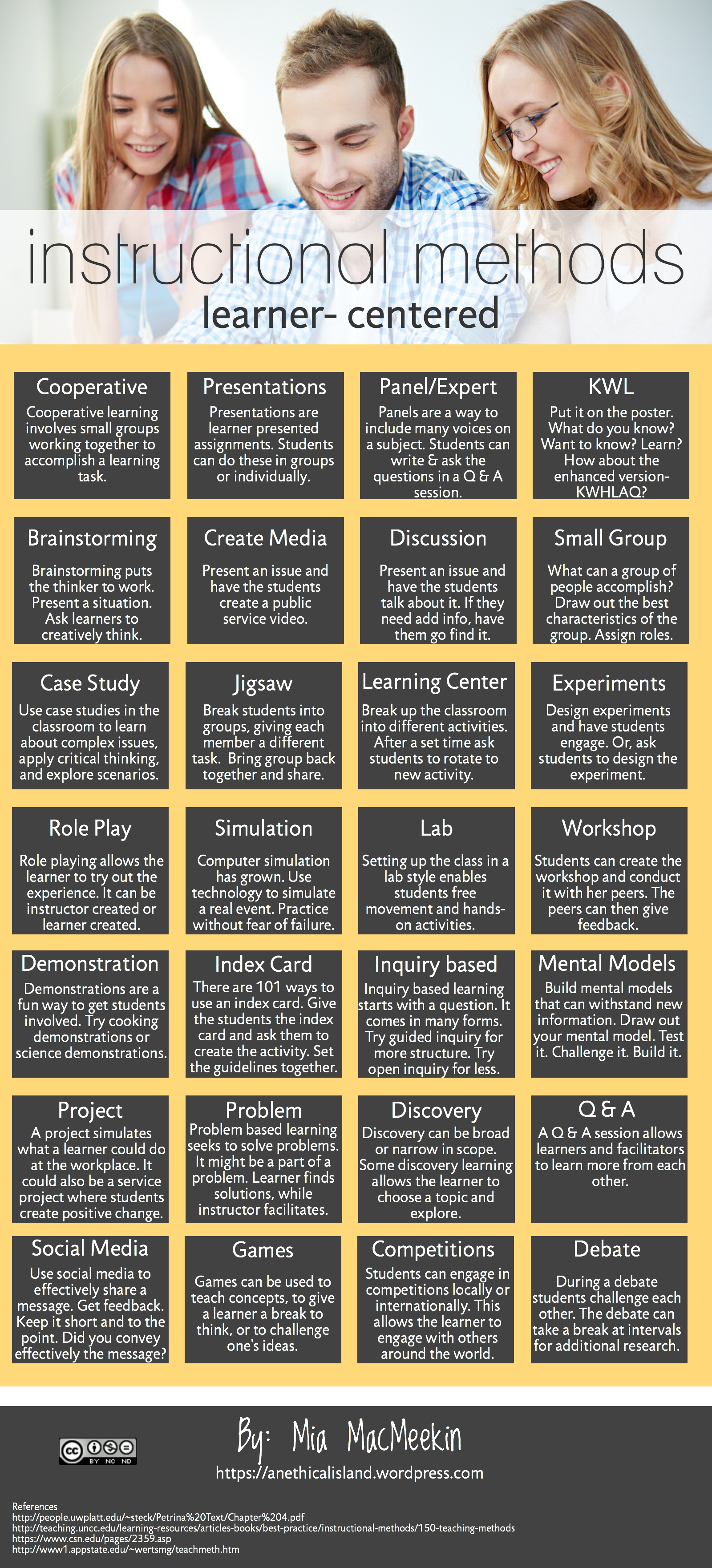
STUDENT CENTERED INSTRUCTIONAL METHODS

I’m a teacher. Now what do I do?
There are several ways to engage learners in the classroom. Here are a few ideas if you get stuck.
Instructional MethodsStaff Spotlight
This week I would like to shine the spotlight on Andrea Hidock.  After several years of teaching 3rd grade, Andrea agreed to move up to 4th this year and serve as grade chair.  What she may not have expected was to have a grade level with two brand new teachers.  In just nine short weeks, Andrea has cultivated a team that works well together and has fun.  Moving to a new grade level can be a challenge for even the most veteran teacher.  Supporting new teachers means anticipating what they will need and showing them things that we often take for granted.  It also means maintaining a positive attitude to ensure that our new teachers do not get discouraged.  Andrea does all of this and more. In addition, she is doing great work with the PBIS Committee and changing the way we approach discipline at Medlock.  I am thankful for Andrea's dedication to our students and staff and I know her grade level appreciates her as well.

Thursday, October 6, 2016

Week of October 6

               Thursday Thoughts October 6


According to the 2010 US Census, there are more than 56 million people in the U.S. with special needs. This is the equivalent of 19% of the population or just shy of 1 out of 5 people.  Over the years,schools have seen an increase in our special needs student population yet we have not always been given the tools that we need to best meet their needs.  While there are specific instructional strategies necessary to better accommodate children with special needs, there are also traits such as empathy, patience and compassion that truly shouldn't have to come from a professional development course or a training session.  This week I had the opportunity to attend the fashion show featuring special needs children and adults as models.  It was wonderful!  I also had a chance to speak with our PTO President, Keri Michaelis, about a struggle that she is experiencing with her son, Foster.
She shared her Facebook posting with me and I want to share it with you.  Teaching children with special needs is challenging.  No one disputes this.  But as we are striving to give them a chance to thrive in the general education environment, please consider what we can do to help  cultivate an environment that embraces them and encourages their peers to accept them as well.

#fostersbirthday


This was posted on Sunday, October 2, 2016 on facebook and it has 1,810 reads and 583 shares as of today.
==============================================================

Tomorrow is Foster’s 15th birthday. Most of you know he was diagnosed with Asperger’s syndrome, a high functioning form of autism, when he was 2 and we have shared his journey every step along the way. Asperger’s is a developmental disability which affects his ability to communicate and socialize. Last week, I posted a very honest description of what it’s like for me as the parent of a child with autism. Foster has just started high school in August. He wanted to go to Homecoming and mustered up the courage to ask a few girls and it didn’t work out: one already had a date, one wanted to go with a group, and one had plans with her family. My heart broke as I saw my Facebook feed flooded with images of the children he’s attended elementary and middle school with over the years, posing happily with their corsages and excited smiles. I am happy that they are experiencing the joy of high school and friendships and new experiences and their parents seem proud too, wondering where their little toddlers went and how they ended up in high school already. But the heartbreak I feel as a parent of a child who wants to be part of the regular high school experience but doesn’t have the skills to know what to do in order to fit in is just awful.
You see, when Foster was in elementary school, I organized everything: neighborhood activities, big birthday parties, play dates, outings, family vacations, and fundraisers. I am a person who includes others in an effort to not make anyone feel left out. I made a choice to include Foster in everything so he could learn how to be more social even though it wasn’t natural for him. The reality is that the older he got, the more I withdrew from organizing everything on his behalf, figuring that part of the transition from childhood to adulthood was learning to be more independent. He is very involved in Boy Scouts, our church, volunteering and academic bowl at school. He even won the National History Bee at age 11 and is a whiz in spelling, geography and social studies. He is not the kind of kid who is coordinated enough to join a sports team – we’ve tried most of them at some point – but because of his low muscle tone, it’s just not in the cards for him. He is very involved and has a very supportive family, but he has always struggled to make friends.
This is his harsh reality. Foster did not have a group of friends who asked him to join them to go to the dance together last weekend. Although his peers were mostly civil to him, he sat alone through most of middle school at lunch every day. He doesn’t get text messages from kids to see how he’s doing. He doesn’t get invited to birthday parties. None of the other kids have ever invited him to grab a movie. He has never been given the choice to attend the Friday night football game and doesn’t want to go with his parents…no one has ever asked him if he’d like to join them. He found the courage to ask a few people if he could sit with them those terrifying first few days of high school, but now retreats to the media center every day because it’s not as scary as the cafeteria. He eats alone outside of the media center before going in to read because it gives him something to do. He doesn’t get included in sleepovers. He is completely alone. What teenager wants to be by themselves all of the time? If he used braces on his legs, would you take them away from him and just see how it worked out for him to be able to walk to the door from the car each morning? If he was hard of hearing, would you rip out his hearing aids and hide them? Why are we as a society OK with not actually engaging individuals who have deficits in communication and socialization? What will these kids become as young adults and working professionals if they are left to sit around alone playing video games and feeling completely left out?
After my post last week, I heard back from several of my autism Mom friends all over the country. Foster is not alone. There are thousands of other Fosters in schools all across America who are in the exact same position. They are completely by themselves and are never included in social activities. Compassion begins at home and all it takes is one friend to seek out another who needs a friend. Kindness is contagious. I realize that it’s not always cool to be friends with the “weird kid” and you have a reputation to uphold, but trust me that the benefits of being kind and persistent just might surprise you.
I’ve noticed in the news lately that lots of kids are getting recognition for being kind to kids with developmental disabilities, like the high school football quarterback who won Homecoming King and promptly turned his crown over to the boy with Cerebral Palsy to crown him instead. Also, the boy with autism in Florida who was sitting at the lunch table all alone and the Florida State football player who pulled up a seat next to him. Now, apparently the kids are all sitting at his table so he is no longer alone. What I want to know is have these kids taken it a step farther and when they’re all getting together to go out for ice cream, do they think about inviting the lunch table kid? Was it a one-time thing or are they challenging themselves to be kind people in their daily lives?
In honor of Foster’s birthday, I ask that you SHARE this post to help spread awareness. I ask that you sit down tonight with your children and talk to them about Foster and other kids like him who have “invisible disabilities.” Autism Speaks recently shared a quote which really hit home for me – “A child with autism is not ignoring you. They are waiting for you to enter their world.”
I pray every day that he will find one friend who will appreciate him for his sense of humor, his intelligence, his kind heart and so many of the amazing gifts he has to offer this world. So many of his teachers have said that he has changed their lives for the better…why hasn’t this happened with any other children?
Think about the kids in your community, at your school, at your church, on your street…are there any kids who are often alone? Challenge yourself to send them a text once in a while to see how they are doing. Invite them to your birthday party. Talk to them at their locker one morning. Knock on your neighbor’s door and ask them if they want to play outside. Include them in a social activity like a football game, a trip to the mall, or just to play Xbox. Then a week or a month later, do it again. Sit next to them on the bus. Walk with them to school in the morning. Find out what interests them and strike up a conversation about something you know they love. These kids need more than autism awareness. They need real friends who can help them navigate the scary social world. Foster will strengthen his social skills in a real setting, preparing him for the world that awaits him beyond high school. You just might improve your character and find a forever friend along the way. And together, we can make an actual difference in this crazy world. #fostersbirthday | Facebook

Staff Spotlight 
This week I would like to shine the spotlight on Amanda Coleman and Karen Gilbert.  Our ESOL student population is growing exponentially.  In fact, we now have close to 90 students being served in the ESOL classroom.  We also have many students that are on ESOL monitored status.  Amanda and Karen are going above and beyond to not only keep our program afloat, but they are committed to transforming it into one that provides the best instruction for students.  

While Amanda is a veteran teacher, this is her first year teaching ESOL.  The numerous rules, regulations and compliance demands can be taxing on the most experienced ESOL teacher, let alone someone new to the position.  Amanda, like most right now, is a bit overwhelmed but she is taking it day by day and making the best of a tough situation.  

Karen's knowledge and steady presence has held this department together over the past few years.  In my five years as principal, Karen has supported the program through five different teachers.  Her commitment to our students and staff is unparalleled.  She has shown that she can work with any teacher because she focuses on doing what's best for students.   

I am thankful for these ladies and their dedication to MBES.  I know that they are appreciative of the support and encouragement that they have received from different teachers.  In the next few weeks, we hope that we will get a new teacher to join this dynamic team and make great things happen for students.

Thursday, September 29, 2016

Week of September 29

          Thursday Thoughts September 29


I know you are stressed right now.  You need a break.  I can hear it in your voice, see it in the slow steps that you take down the hall and most importantly I see it in your eyes.  You have every right to be exhausted.  The last 8 weeks of school have been tough.  When you count up the many hours of plans, papers, grades, conferences, emails and don't forget teaching, it is enough to make the best of us scream.    But I am here to tell you to hang in there.  We have a four day week next week and then we have a couple of days to get ourselves together and breathe. This part of the year is always hard and it seems to linger on forever. But with the cool Autumn air comes an opportunity for us to get into a better flow, cross off some of those mundane beginning of the year tasks and realize that we are a lot further ahead than we feel.  You are a phenomenal staff and together we make a phenomenal team of adults focused on doing what is best for phenomenal kids.

Staff Spotlight
This week I would like to shine the spotlight on Ainsley Kurtz, Carolyn Hutchins and Charmian Solter.  I can't begin to tell you how dedicated these ladies are to their students. Sometimes we can get so wrapped up in our own classrooms and departments that we have little regard for what others are going through.  I can assure you that these ladies are put to the test everyday.  When they come to work, they know that the day will be long, hard and often precarious.  Yet they come each day with a renewed sense of commitment to their students.  They look for small victories and give their students a fresh start daily.  I am thankful for these ladies and the heart that they have for children with special needs.  Most importantly, the parents of these children are grateful that there are staff members that treat their children like....well....children who deserve to be loved in spite of their behavior.


Thursday, September 22, 2016

Week of September 22


               Thursday Thoughts September 22


Yesterday Martha shared an interesting MBES fact with the staff.  Our student body speaks over 26 different languages.  That is amazing!  The diversity at Medlock Bridge has increased exponentially over the past decade.  Our school is a microcosm of the interconnected global society that students  will one day live and work in as adults.  Whether they choose to live and work in the US or abroad, we are raising a generation of people who will be more tolerant, understanding and hopefully more respectful toward each other than any generation prior.  When I see the students collaborating in class or  laughing and playing together at recess, it makes me proud to be the principal of a school that embraces ALL children.  Thank you for the work that you are doing to make sure that Medlock Bridge is a place where EVERY child feels loved and valued.


Staff Spotlight
This week I would like to share an email that I received.  I wholeheartedly agree with the sender of this email and think that Jennifer Birkmeyer is worthy of this week's spotlight.

"Every morning I am at work, I open my door sit down at my desk only to hear the enthusiastic voice of Jennifer Birkmeyer.  I don’t know her very well at all and only know the sound of her voice, but I am just so amazed at how she carries on the whole day.  From what I am hearing she is exactly the kind of teacher that I would want my children to have.  Jennifer always, I mean always has energy. She is getting the children energized and excited all the time. I constantly hear cheers in her classroom. Her words are always filled with encouragement and truly has the vibrant personality needed to teach a room full of 1st graders that always keep you on your toes. I just wanted someone to know that it has been a joy to listen to her teach her class every day. She’s got a lot of kick and I’m so inspired by her!"

Jennifer your passion for teaching children is amazing and we are thankful that you are a part of the MBES Team.


Preparing for Cultural Diversity: Resources for Teachers


Edutopia