Thursday, March 26, 2015

Week of March 26


Thursday Thoughts March 26


  Today I participated in a full day of principal training on Blended Learning.  My goal was to remain fully engaged for the entire time and try not to get overwhelmed.  I met one out of the two goals. The training was a part of my requirement as a Cohort 1 principal embarking on Personalized Learning.  As I conversed with colleagues, I realized that we are doing some extraordinary work here at Medlock.  It was wonderful to share how we are approaching our professional development in a differentiated way.  I was excited to share how our students are participating in Genius Hour, using a variety of apps for presentation and even coding in grades as young as Kindergarten.  The greatest common factor in all of the things that I shared today is.......YOU.  You have embraced the idea that we have to teach differently and that students can and should take ownership of their learning.  You have decided to take risks in the classroom and become more flexible in how you teach.   You have encouraged students to "show what they know" in a variety of ways.  You are the reason that our ordinary curriculum is being taught in extraordinary ways.  You make the difference at Medlock.


Staff Spotlight

This week I would like to shine the spotlight on Ashley Mason. Ashley has become a "go to" person for classroom coverage.  In fact, she has even offered to help us out in tough to cover classrooms or when we are in a bind.  Ashley agrees to extra shifts in the cafeteria without complaint.  Teachers have commented that they appreciate the way she follows the plans that are left and holds the students accountable.  We know how hard it is to get pulled to cover a class at a moment's notice.  Ashley thank you for your willingness to support our students and staff everyday.


4C's: Collaboration, Communication, Creativity, Critical Thinking Skills


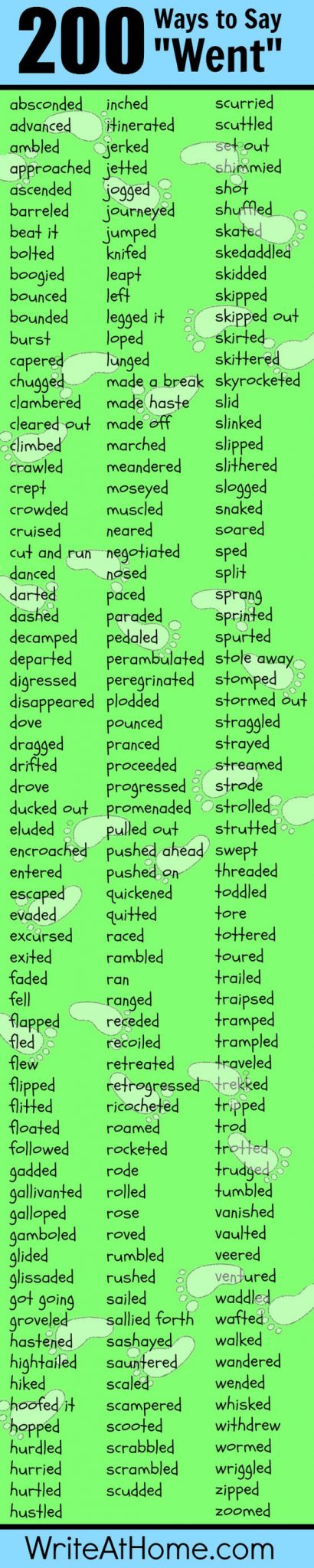
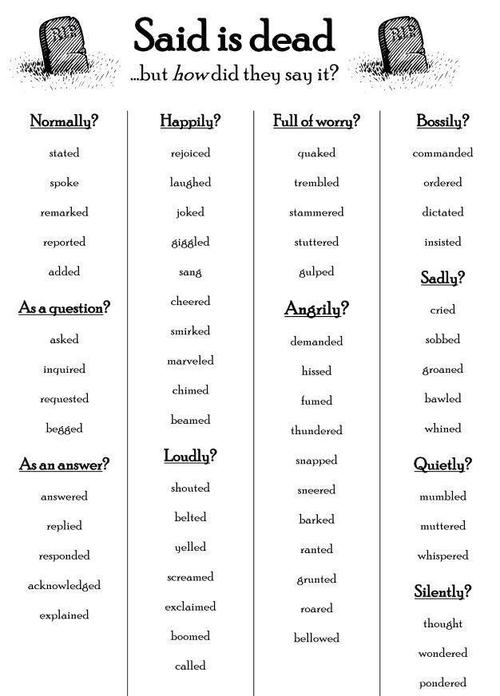
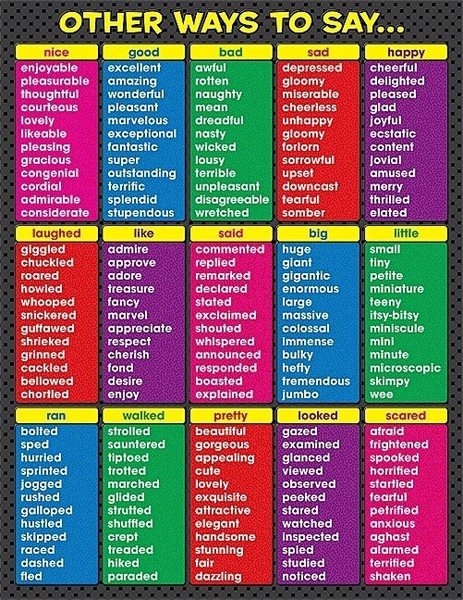
600 Other Ways To Say Common Things: Improving Student Vocabulary

,

Your students are bright, but they don’t always sound like it.
Their diction is full of cliche and emaciated language that doesn’t reflect their inner voice, nor does it indicate their vocabulary level.
You want your students to use specific language that demonstrates intended meaning rather than the first word that popped into their head, but you want to do more than hand them a thesaurus and tell them to “figure it out.”
While the following graphics aren’t going to make that happen, they can certainly play a role if posted to your classroom blog, shared on a student-teacher pinterest page, hung on a classroom wall, or reformatted, printed, hole-punched, and stored in a student binder.
200-ways-to-say-went-infographic
said-is-dead
other-ways-to-say-cliche-words


Technology Tidbits

http://resources.oswego.org/games/ - great math games for all grade levels

News & Notes

Dr. Scott Muri, FCS Deputy Superintendent, will be visiting Medlock on May 12th after school to discuss the Personalized Learning Initiative taking place in FCS. 

Thursday, March 19, 2015

Week of March 19


Thursday Thoughts March 19


 What an amazing day you had today!  I'm just sorry that I missed it.  Thank you to those who sent me pictures.  I was proud to share them with my principal colleagues.  Quite frankly,  I couldn't tell who was having more fun, the students or the staff.  One of the many things that I love about being a Mustang is the way we can put the FUN back into teaching the fundamentals.  I know the children enjoyed dressing up and were excited to see you dress up as well. Your love and dedication to our students is unparalleled and I know they will remember fun days like this for years to come. 


Staff Spotlight

This week I would like to shine the spotlight on Rachna Saxena.  Rachna originally came to Medlock for a long term sub job during Mrs. Gallagher's maternity leave.  A few weeks later, Ms. Plummer had a vacant assistant position in her classroom and Rachna graciously accepted the position.  Initially, the transition in personnel was a bit difficult for some of the students.  This resulted in the students physically acting out a little more than usual.  There were a couple of times that I thought she would throw in the towel, but she did not.  Rachna hung in there and formed a bond with the class. It has been wonderful to learn how the students now respond to her positively.  When she is with students, one of the first things that you will notice is her bright smile.  I am thankful for the assistance that Rachna is providing to Ms. Plummer's class and appreciate the way she cares for our students.


Mindset Moments: Showcasing Student Growth

 
By Kriscia Cabralon March 5, 2015


Take time to reflect on student learning and create “Mindset Moments.” To learn more about mindsets in the classroom, and especially the difference between fixed and growth mindsets, please check out my earlier post on this subject, "New Year, New Mindset."
Once a week I highlight a picture book that deals with perseverance and a growth mindset connection. After the read-aloud, we discuss the character in the story, the challenges they faced, and how they used a growth mindset to persevere and grow. Below is a small collection of stories we've read this year for this purpose.

This week I wanted to take the focus off of the characters that we read about, and move it to my students and how these lessons apply to them in their daily lives.
I asked students to think about the growth mindset and all that we have learned about it so far. I asked them to share what they know with the class. I got responses that included:
  • “Growth mindset is when you keep trying even when something is hard.”
  • It’s when you want to keep learning even when you know a lot already.”
After my students told me what they know about growth mindset, I asked them to turn and talk to a partner about the following questions: “Can you think of a time where you used growth mindset? How did your changed mindset help you grow?”
After the partners worked with each other for a short while, I called upon students who had an example in mind to share their stories with the class. I posted a sentence starter on the board for those who needed more prompting.
I asked students why it is important to share and learn from each other’s mindset moments. We discussed how we can go to each other for help. I also talked about how important it is to celebrate the success of others and learn from their experiences.
I wanted to keep the mindset moment energy flowing through our room. To do this, I created a poster using chart paper. I then asked students to take a moment and write down their moments on a sticky note. They could then post growth mindset moments whenever they experienced one and we could share and celebrate as a class.
Students took a few moments for some quiet think time, and then grabbed sticky notes and went for it. Not every student had something to share. Those students were encouraged to take a sticky note and write about what they are going to learn and do better.
After a few minutes of reflection time, students shared their moments with the class and then stuck them on our poster. It was empowering for them to voice their growth and exciting for us to see a peer face a challenge and succeed.

Plans for the Future

The mindset poster will be hanging in our room indefinitely. I plan to expand the poster when our first one runs out of room. There is so much power behind seeing other students' accomplishments in a strong visual representation. In our first attempts to share, it started as only a few voices willing to speak. By the end of our time, however, students were leaving to go home with a pack of sticky notes thinking about their growth mindset moments that they wanted to share!
It would be great to have students type up their mindset moments and create a book that documents how much they have grown throughout the year.
What might you do with your students growth mindset moments? I’d love to hear more ideas!


Technology Tidbits

http://www.funenglishgames.com/writinggames.html- a range of free activities, resources and practice exercises related to writing letters, stories, newspapers, debates, advertising and instructions.

News & Notes

In May we will hold elections again for School Governance Council.  We will elect one teacher representative and one parent/guardian representative.  Please stay tuned for more information regarding the eligibility guidelines and the process.


Thursday, March 12, 2015

Week of March 12

Thursday Thoughts March 12


 It has been wonderful this week to see the students get so excited about our school wide reading initiative.  I think we as adults don't truly understand the influence that we have on children.  They hang on our every word and our actions make an impression on them.  This can either be good or bad depending on our words and actions.  It is one thing to tell a child that reading is fun but it is another thing to model it for them.   When teaching in an affluent area such as Johns Creek, it can be easy to assume that all of our students have a wealth of books at home and parents who can't wait to read to them.  Unfortunately this is not the case for every child.  For some of our students, school is the best part of their lives.  You provide consistency, high expectations and experiences that they might not have outside of school.   Thank you for all that you are doing to make Medlock Bridge an awesome place for kids to learn.


Staff Spotlight
I would like to shine the spotlight on Ana Moreno and Cindy Olson.  These ladies have truly stepped up and increased their technology use among students within the classroom.  Ana is using Chatterpix as a way to have her students present information and she has added a Symbaloo to her classroom website as a resource for her students and parents.  Cindy has implemented KidBlog and her students are getting really excited about blogging.  Cindy is not afraid to learn right alongside her students and has embraced the support that our KSU Instructional Technology Coach provides.  Ana and Cindy are just a couple of the teachers who are throwing caution to the wind and getting into the trenches of technology use.  Great things are taking place in their classrooms and I appreciate their dedication to students and willingness to try new things.


4C's: Collaboration, Communication, Creativity, Critical Thinking Skills

4 Seuss and STEM Activities

By Lindsey Petlakon March 11, 2015


March is here and that means celebrating Dr. Seuss's birthday and Read Across America in a number of fabulous ways all month long! I’m a total #STEMnerd and am always game for integrating STEM into seasonal festivities (see my STEM Valentine’s Day post). I loved sharing my "Top 10 Read Across America Ideas for Upper Elementary," and am excited to share ways to incorporate some Seuss-tastic STEM into your festivities at any grade level!
 

Bartholomew and the Ooblek:

Your kids will have a blast getting ooey-gooey with this fun, hands-on science experiment exploring changing states of matter. See my photos below for real class-tested, teacher-approved photos from our own Ooblek experiments and watch the step-by-step video by Steve Spangler for instructions on how to bring this Seuss-tastic science into your own experiment! This experiment is simple, fun, and great for any age.

Ten Apples Up on Top:

I LOVE an engineering challenge, and so do my kiddos. Each week, my colleague Jenna Weinstein and I get our kindergarten and fourth grade classrooms together for literacy-inspired STEM challenges during our STEMagination Station sessions. Naturally, we jumped at the chance to celebrate Seuss’ birthday with some STEM fun, and found Ten Apples Up on Top to be a perfect fit for our weekly STEM challenge.
Students were given Keva planks (but you could use ANY building materials, purchased or recycled) and were asked to build a structure at least one yard tall that could balance and hold at least one apple “up on top.” Once students achieved that goal, they worked to improve their engineering designs to add more apples to their structures. In the time we had, students were able to support up to four apples on their yard-tall towers.


The Lorax:

This book is such a wonderful story for so many reasons, especially when considering eco-friendly issues and topics of concern. Last year I tried an experiment simulating an oil spill, its impact on wildlife, and cleanup with my class for the first time. It was amazing on all counts, easy to execute, and used household items to make real-world ecological issues come to life in the classroom. Read my previous post, "Real World Science: Gulf Coast Oil Spill," for full details, pre-experiment prep, tech integration, and more!

One Fish, Two Fish, Red Fish, Blue Fish:

This super simple book lends itself to numerous literacy and math activities (including graphing Goldfish colors), but it’s also great for engaging science lessons on colors and color combinations. One of my favorite color explorations is a color-changing milk experiment that is sure to please. Like the oil spill simulation above, I tried this milk and food coloring experiment (courtesy of Spangler) and was more than 100 percent satisfied. With few materials needed and lots of fun for all, this STEM activity is great for any age and pairs perfectly with this classic Seuss tale.
 
Technology Tidbits

 http://www.tvokids.com/gamesThe math and science games on this site are wonderful for working on many different math concepts, including counting coins, addition and telling time. In addition, there are great videos that demonstrate various math concepts (click on Watch to view videos).

News & Notes

Please sign up to read at Barnes & Noble Night on next Wed, March 18th. 
Please click here: http://vols.pt/vzycxg


Thursday, March 5, 2015

Week of March 5

Thursday Thoughts March 5


A few weeks ago I had to work a concession stand shift at Chattahoochee High School. During my shift, one of my former Abbotts Hill students walked up to the stand.  I immediately recognized him even though it had been six years since we'd last seen each other.  He is now a junior.    This young man was one of the first Autistic students that I had ever worked with in my capacity as an assistant principal.  We spent ALOT of time together from the time he was in second grade until he went on to middle school.  In fact, I still have a framed picture of me and this student in my office.  He walked up to the concession stand and said, "Hi Mrs. Hutchens, I want a popcorn."  This small interchange was significant to me because he was never one to say much to me.  I told him that I was surprised that he remembered me and I tried to ask him how he's been but he ignored my questions and proceeded to ask for the popcorn again.  Needless to say, I smiled to myself, got the popcorn and he went on his way.   I wish I could tell you that I made some profound impact on his life or that I noticed a huge change in him, but I can't.  What I can tell you is that during our time together, I treated him with love and compassion even when it was difficult.  Even when he was wailing in my office, throwing things around and yes even being suspended, I made sure that he knew that although I did not love his behavior, I still loved him.    You may never know if you have made a positive impact on a child's life but I hope that as you work with all children, you make that your goal. 


Staff Spotlight
This week I would like to recognize Kate Johnston.  Being a new teacher at Medlock can be challenging to say the least.  The expectations of lesson planning, differentiating every lesson and even parent communication are all bit overwhelming.  Kate has grown tremendously throughout the year.  She uses feedback to improve her instructional practices and understands the value in collaboration with her team.  She loves her students and has taken the time to really get to know them.  Kate, thank you for giving your best to our students everyday. 


  4C's: Collaboration, Communication, Creativity, Critical Thinking Skills
 

The Profile of a Modern Teacher


One of the greatest misconceptions in education today is that certain teachers have a higher natural aptitude in technology than others.
This inspirationalgraphic sets out to disprove that notion and remind the audience that external skills are only a function of the internal dispositions that allowed them to grow.


Technology Tidbits

 http://www.cobbk12.org/sites/literacy/math/math2.htm- Over 70 different links to math sites sorted by topic.

News & Notes

Dr. Avossa's visit to Medlock Bridge will be on Wednesday, April 22nd at 2:45pm in the Media Center.  Please email me any specific topics that you would like him to cover. 

Thursday, February 26, 2015

Week of February 26

Thursday Thoughts February 26

 
I figured out what we love about snow days.  It is definitely not the snow (or dust, considering what we've had).  We enjoy the unexpected and unplanned time off.  Think about it, we get scheduled days off throughout the year but we have so much to do on those days that we lose sight of the value of the time "off".  A snow day is an impromptu event that forces us to stay home.  If you are like me, you get a rush when you see our system pop up on the news or when the call comes through.  Even though we know that we will have to make it up in some capacity, we still get a tinge of excitement when school is called off.  In some ways, we are just as excited as the kids.
 
On the flip side, four snow days can cause a bit of anxiety.  We start to think about when we will make up the days and how we will cram four days of missed instruction into our students. In fact, it doesn't take long for the euphoria to wear off.  I guess it is true that you can have too much of a good thing.  As we get back into our groove (and cross our fingers that we have seen the last of the snow) I hope this unexpected break has given you a little boost and the energy to make it to Spring Break.    As soon as we have word regarding make up days, I will let you know.


Staff Spotlight

This week I would like to shine the spotlight on our ESOL Team, Melinda Gallagher, Michelle Metcalfe, Karen Gilbert and Joy Kim.  Our ESOL program has grown to well over 70 students and counting.  Not only have we experienced phenomenal growth, but we also have over 200 students in our building whose families speak a language other than English.  Needless to say, this team has their work cut out for them.  While Melinda and Michelle provide daily instruction for students, Karen and Joy provide support to the program in their own way. Karen provides support in the classroom alongside the teachers and Joy works with the parents to help them navigate our educational system.  Currently Joy is using Rosetta Stone to teach parents English.  Melinda and Michelle have just completed ACCESS Testing which is a standardized test that each of our ELL students must take.  I often say how important each department is to the success of our total school program.  The ESOL Team is integral to the success of our school and I am thankful for the work that these ladies do everyday.


  4C's: Collaboration, Communication, Creativity, Critical Thinking Skills


50 Questions To Help Students Think About What They Think


national-assembly-for-wales-metacognition50 Questions To Help Students Think About What They Think
by Lisa Chesser
Using the right questions creates powerful, sometimes multiple answers and discussions. Aristotle said that he asked questions in response to other people’s views, while Socrates focused on disciplined questioning to get to the truth of the matter.
Ultimately questions spark imagination, conjure emotions, and create more questions. The questions asked by a teacher or professor are sometimes more glaringly valuable than the information transferred to the students. Those questions spark a thought, which leads to a fiercely independent search for information.
If students are the ones gathering that information then they’re the ones learning it and student-driven learning cements lessons into the students’ mind making any lesson more powerful with this strategy. Even though the following list of questions are broken into Mathematics, Literature and Science and Social Science, it’s really just a set of philosophically challenging questions that should be applied to any learning environment.
The questions are unrestricted and open the mind up to unfettered thought, perfect for innovation and understanding. The sections begin with Mathematical Questions because for the purpose of this list they’re the most general and therefore the most useful.
 
Logical Questions
Within the realm of mathematics, there are certain types of questions that build up to those aha moments or topple barriers. Those are the questions that change a learner forever. They change a person because finally, the answers can only be found within.
The addition of philosophical questioning to mathematics enhances critical thinking in every learner. Basic principles of understanding help create solid ground, but questions build powerful architecture with which structures tower over one another.
Reflection & Collaboration
1. What do you think about what was said?
2. How would you agree or disagree with this?
3. Are there any other similar answers you can think of with alternative routes?
4. Does anyone in this class want to add something to the solution?
5. How might you convince us that your way is the best way?
Self-Reflection
6. How did you determine this to be true?
7. Why didn’t you consider a different route to the problem?
8. Why does that answer make sense to you?
9. (in response to an answer):…what if I said that’s not true?
10. Is there any way to show exactly what you mean by that?

Reasoning

11. Why do you think this works? Does it always? why?
12. How do you think this is true?
13. Show how you might prove that?
14. Why assume this?
15. How might you argue against this?

Analysis

16. How might you show the differences and similarities?
17. What patterns might lead you to an alternative answer?
18. How many possibilities can you think of and why?
19. Predict any number of results?

Connections

20. How does this relate daily occurrences?
21. Which ideas make the most sense and why?
22. Which problems feel familiar? Why?
23. How does this relate to current events?
24. What kinds of examples make this problem workable?
25. What other problems fit this style or example?
 
Literary Questions
Buried in every story lives a student’s own life. Anyone can relate to at least one character or dive into at least one plot twist. But, the more foreign a story, the more important the questions should be.
Students may resist the idea that they can relate to certain characters depending on their ethnicity or economic background, but deep, concentrated questions show students the story really isn’t that foreign at all and also guide students to deeper meanings.
The following questions could be applied to any story, no matter how long or short, difficult or easy. Vary them and add to them depending on how the discussion flows.
26. How did any of the characters or events remind you of yourself? Why?
27. How did the character’s actions affect you? Explain.
28. If you were this character, how would the story change?
29. What surprised or confused you about the characters or events? Explain.
30. Why do you think the author wrote from this character’s view?
31. What do you think the author is trying to accomplish?
32. How is the author thinking about the world?
33. How would the story change from another character’s view?
34. Why do you think this story could actually happen, or not?
35. How can this story teach us something about our lives?
36. How do you think the characters resolved the major conflict in the story?
37. How would you have resolved it?
38. How would you change the end of the story and why?

Science and Social Questions

Within the idea of the Scientific Method, the hypothesis stands as the ultimate question. But, there are so many more questions a scientist must ask in order to answer that one question.
The challenging questions, however, make this a universal process streaming into other subject matter and delving into deeper waters. Here are some questions to sink into and use across curriculum as well as within science itself.
39. What’s the purpose for this experiment or argument?
40. Would you elaborate on the purpose of this?
41. What issues or problems do you see here?
42. What evidence or data are given that help make this worthwhile?
43. What are some of the complexities we should consider?
44. What concepts help organize this data, these experiences?
45. How can you justify this information?
46. How can we verify or test that data?
47. What details can you add to make this information feel more complete?
48. Which set of data or information is most relevant or important?
49. How is all of this consistent or inconsistent?
50. How am I seeing or viewing this information? Objectively or subjectively? Should I then change my view?
 
 
Technology Tidbits
 http://www.gynzy.com/- Free interactive board lessons for grades K-8 in all subjects (you will have to register for the site). 

News & Notes


Volunteers Needed for  FCS Science Olympiad: For the very first time, Fulton County is hosting a Regional Science Olympiad Competition for 22 elementary teams from our learning communities. We are looking for 20 teachers who would be willing to work at the competition. It will be taking place at Centennial High School. Teachers should be able to commit to working from 8 a.m. until 1 p.m. on Saturday, March 21st. A stipend will be given to those who are able to help us out. Please email Amy Kilbride, NELC STEM Program Specialist at kilbride@fultonschools.org if you are able to assist us!


Thursday, February 19, 2015

Week of February 19


Thursday Thoughts February 19


My son (the sophomore) is failing Chemistry.  This is a big deal because this is the first class that he has ever been in jeopardy of failing.  I am not in panic mode just yet because I believe that he will pull the grade up before the end of the semester (and because my college son has failed quite a bit more than Chemistry).  I can tell you that he is handling it much better than I thought.  He is seeking additional help after school and I see him studying a bit more than usual.  So I am using this opportunity to evaluate my parenting. Of course I want to rush in and fix this.... meet with the teacher, get a tutor, complain to an administrator (you know, the usual).   However, I have learned (the hard way) that failing is a part of learning.  Now don't get me wrong, I don't plan to let the boy fail this class but I will use this as a teachable moment.  Failure gives us a reason to keep trying, step things up and seek new ways to do things.  As elementary teachers, one of the best things we can do for children is provide an environment where students are presented with problems, given an opportunity to fail and then encouraged to try and try again until they meet with success.  


Staff Spotlight

This week I would like to shine the spotlight on Erin Amideo.  Erin is the Kindergarten Grade Chair and she really advocates for the teachers and students.  Erin does not hesitate to come to us with questions or concerns as it relates to the team.  Early in the year, Erin explained how tedious the SLO testing was for Kindergarten.  As a result, we worked together to come up with a solution that would make the best out of a tough situation.  There have been other things that she has championed  throughout the year and she works to find a resolution that everyone can accept.  Erin, thank you for what you are doing for students and staff.


4C's: Collaboration, Communication, Creativity, Critical Thinking Skills


Five Minute Reading Responses

By Genia Connellon February 14, 2013
www.Scholastic.com


Nearly every day, my students have independent time built into our reader’s workshop. During this time I am meeting with small groups and trying to work with at least two to three students individually. While I would love to conference or even converse with each student about their independent reading book, time just doesn’t allow for this on a daily basis. However, having them respond to their reading in writing provides a window into their thinking and understanding. A few weeks ago I shared my reading response forms and graphic organizers for independent reading, which are an integral part of my reading program. There are some days, however, when there is only time available for a short response. This week I’d like to share with you how I get my kids thinking about their reading and sharing their thoughts in five minutes or less.

Reading Response Blogs

My class uses Kidblog to share their thoughts and feelings about books. While my students love to “blog” in response to their own independent reading books, they especially enjoy commenting on our class read-alouds. I will often begin a thread by posing a question or comment of my own, and the students soon take over. Because read-alouds provide us with a common text and experience, students not only leave their own thoughts, but become fully immersed in the process, replying to the comments of others. My 3rd graders can hardly wait to see if anyone has commented on their posts, making this five-minute reading response one of the most engaging we do.
If you have wanted to try blogging with your class, Kidblog may be a good place to start. It is very easy to set up and the teacher gets to approve all comments before they are posted.
The images above show blog threads that my students have started along with a few of their responses to a question I posted about our current read-aloud book, Wayside School Is Falling Down. Within ten minutes, there were 54 comments posted by the class!
Third grade bloggers hard at work!

Reading Tweets

My 3rd graders are very aware of social media and love to partake in this classroom version. When we “tweet” about our reading, it needs to be a thought about their book stated in 30 words or less. I normally help guide them with prompts such as What are you thinking or wondering about your book right now? or How has one of the characters changed since you started reading? Many students also enjoy adding their own hashtags related to the title of the book or the theme of their tweet.

Reading Response Tic-Tac-Toe

For years I have used a tic-tac-toe board as a way to give students a choice with their weekly spelling/word study words, so I decided to apply the same concept to reading response. On days when students are doing a “shorty” response, as they call it, they can choose an open square on the tic-tac-toe board and respond to it on a page in their reading binder. Part of the fun is trying to achieve a tic-tac-toe, but students are actually answering prompts that are within, about, and beyond the text.
Click on the images above to download a customizable tic-tac-toe board and the reading response paper my students use to respond.

3, 2, 1 Response

This “countdown” response focuses on the basics. Using this half-page sheet, students provide information about their reading, touching on summarizing, sequencing, vocabulary skills, and the asking questions/wondering comprehension strategy we work on in reading. Click the image below to download the 3, 2, 1.

"At First I Thought . . . And Now I Think"

By this time of year, my 3rd graders are becoming much more sophisticated readers; they are beginning to recognize that characters and plots evolve as the story progresses. This At First I Thought . . . response allows them to share how their thinking about a character or story line has changed during reading. I’ve had students fill this response out without its even being assigned because they’ve had a sudden epiphany while reading that they want to put down in words.

Scholastic Resources for Quick Reading Responses

Scholastic is a treasure trove of reading response graphic organizers and reading response ideas. Visit Printables and Teacher Express to check out the huge variety of response helpers. Below you will find just a few that I like. Click on the image to download the free printable.

Assessing Reading Response

These short reading responses give me a snapshot of my students’ thoughts and comprehension on the days I can’t meet with them. When I respond to their writing, I think of it as a form of written conversation between us. Because of this, I only write positive comments about what they have done well or a great insight they have had, which hopefully motivates and engages them further. While reading their responses, I, of course, take note of misunderstandings students may have, or any redirection they may need, and I save those conversations for when we meet face to face.


Technology Tidbits
http://ngexplorer.cengage.com/ngyoungexplorer/- Great nonfiction resource for younger grades and ELL students

News & Notes

The district’s  Fulton Spring Teacher Fair will be held on Tuesday, March 10, 2015 from 10:00am-2:00pm at the Georgia International Convention Center (GICC).  If you know of anyone interested in employment with Fulton County Schools please tell them to go ahead and complete the application and screening process.  At the Teacher Fair, they will be face to face with administrators from all Fulton Schools.