Thursday, February 19, 2015

Week of February 19


Thursday Thoughts February 19


My son (the sophomore) is failing Chemistry.  This is a big deal because this is the first class that he has ever been in jeopardy of failing.  I am not in panic mode just yet because I believe that he will pull the grade up before the end of the semester (and because my college son has failed quite a bit more than Chemistry).  I can tell you that he is handling it much better than I thought.  He is seeking additional help after school and I see him studying a bit more than usual.  So I am using this opportunity to evaluate my parenting. Of course I want to rush in and fix this.... meet with the teacher, get a tutor, complain to an administrator (you know, the usual).   However, I have learned (the hard way) that failing is a part of learning.  Now don't get me wrong, I don't plan to let the boy fail this class but I will use this as a teachable moment.  Failure gives us a reason to keep trying, step things up and seek new ways to do things.  As elementary teachers, one of the best things we can do for children is provide an environment where students are presented with problems, given an opportunity to fail and then encouraged to try and try again until they meet with success.  


Staff Spotlight

This week I would like to shine the spotlight on Erin Amideo.  Erin is the Kindergarten Grade Chair and she really advocates for the teachers and students.  Erin does not hesitate to come to us with questions or concerns as it relates to the team.  Early in the year, Erin explained how tedious the SLO testing was for Kindergarten.  As a result, we worked together to come up with a solution that would make the best out of a tough situation.  There have been other things that she has championed  throughout the year and she works to find a resolution that everyone can accept.  Erin, thank you for what you are doing for students and staff.


4C's: Collaboration, Communication, Creativity, Critical Thinking Skills


Five Minute Reading Responses

By Genia Connellon February 14, 2013
www.Scholastic.com


Nearly every day, my students have independent time built into our reader’s workshop. During this time I am meeting with small groups and trying to work with at least two to three students individually. While I would love to conference or even converse with each student about their independent reading book, time just doesn’t allow for this on a daily basis. However, having them respond to their reading in writing provides a window into their thinking and understanding. A few weeks ago I shared my reading response forms and graphic organizers for independent reading, which are an integral part of my reading program. There are some days, however, when there is only time available for a short response. This week I’d like to share with you how I get my kids thinking about their reading and sharing their thoughts in five minutes or less.

Reading Response Blogs

My class uses Kidblog to share their thoughts and feelings about books. While my students love to “blog” in response to their own independent reading books, they especially enjoy commenting on our class read-alouds. I will often begin a thread by posing a question or comment of my own, and the students soon take over. Because read-alouds provide us with a common text and experience, students not only leave their own thoughts, but become fully immersed in the process, replying to the comments of others. My 3rd graders can hardly wait to see if anyone has commented on their posts, making this five-minute reading response one of the most engaging we do.
If you have wanted to try blogging with your class, Kidblog may be a good place to start. It is very easy to set up and the teacher gets to approve all comments before they are posted.
The images above show blog threads that my students have started along with a few of their responses to a question I posted about our current read-aloud book, Wayside School Is Falling Down. Within ten minutes, there were 54 comments posted by the class!
Third grade bloggers hard at work!

Reading Tweets

My 3rd graders are very aware of social media and love to partake in this classroom version. When we “tweet” about our reading, it needs to be a thought about their book stated in 30 words or less. I normally help guide them with prompts such as What are you thinking or wondering about your book right now? or How has one of the characters changed since you started reading? Many students also enjoy adding their own hashtags related to the title of the book or the theme of their tweet.

Reading Response Tic-Tac-Toe

For years I have used a tic-tac-toe board as a way to give students a choice with their weekly spelling/word study words, so I decided to apply the same concept to reading response. On days when students are doing a “shorty” response, as they call it, they can choose an open square on the tic-tac-toe board and respond to it on a page in their reading binder. Part of the fun is trying to achieve a tic-tac-toe, but students are actually answering prompts that are within, about, and beyond the text.
Click on the images above to download a customizable tic-tac-toe board and the reading response paper my students use to respond.

3, 2, 1 Response

This “countdown” response focuses on the basics. Using this half-page sheet, students provide information about their reading, touching on summarizing, sequencing, vocabulary skills, and the asking questions/wondering comprehension strategy we work on in reading. Click the image below to download the 3, 2, 1.

"At First I Thought . . . And Now I Think"

By this time of year, my 3rd graders are becoming much more sophisticated readers; they are beginning to recognize that characters and plots evolve as the story progresses. This At First I Thought . . . response allows them to share how their thinking about a character or story line has changed during reading. I’ve had students fill this response out without its even being assigned because they’ve had a sudden epiphany while reading that they want to put down in words.

Scholastic Resources for Quick Reading Responses

Scholastic is a treasure trove of reading response graphic organizers and reading response ideas. Visit Printables and Teacher Express to check out the huge variety of response helpers. Below you will find just a few that I like. Click on the image to download the free printable.

Assessing Reading Response

These short reading responses give me a snapshot of my students’ thoughts and comprehension on the days I can’t meet with them. When I respond to their writing, I think of it as a form of written conversation between us. Because of this, I only write positive comments about what they have done well or a great insight they have had, which hopefully motivates and engages them further. While reading their responses, I, of course, take note of misunderstandings students may have, or any redirection they may need, and I save those conversations for when we meet face to face.


Technology Tidbits
http://ngexplorer.cengage.com/ngyoungexplorer/- Great nonfiction resource for younger grades and ELL students

News & Notes

The district’s  Fulton Spring Teacher Fair will be held on Tuesday, March 10, 2015 from 10:00am-2:00pm at the Georgia International Convention Center (GICC).  If you know of anyone interested in employment with Fulton County Schools please tell them to go ahead and complete the application and screening process.  At the Teacher Fair, they will be face to face with administrators from all Fulton Schools.

Thursday, February 12, 2015

Week of February 12


Thursday Thoughts February 12


An emphasis is finally being placed on creativity in education, however I can tell you that it is something that scares the living daylights out of administrators.  Well, I shouldn't generalize all administrators so I will just speak for myself.  You see, one of the characteristics of a principal is that we like things to be orderly and fall into place.  Creativity is hard because there is no right or wrong answer with it.  You don't get credit for it on a standardized test and although it's right for kids, it's a hard thing to measure(and therefore foreign to administrators). But I must say that you are making a believer out of me!  I am impressed with what is taking place in the classrooms and the way that students' are expressing themselves and exploring their interests in ways that are.....creative.  Many thanks to those of you who are inviting us down to see the creative ways students are learning at MBES.  Please continue to share.  Seeing really is believing!


Staff Spotlight

This week I would like to shine the spotlight on Traci Fleck and Reema Ajmera.  Traci and Reema have their hands full with a couple of new students that started after winter break.  They have not only worked to get the new students acclimated to the class, but they have also had to ensure that the other students do not adopt the behaviors of the new classmates.  Traci works closely with parents to alleviate any fears or concerns that they may have as it relates to starting a new program in the middle of the school year.  Both ladies work together to provide a classroom environment that allows students to grow at their own pace.  They are patient with their students and know their unique needs.   Traci and Reema, thank you for the work that you are doing in your classroom. 


4C's: Collaboration, Communication, Creativity, Critical Thinking Skills
 

The Things That Linger After They’ve Forgotten Everything You Taught

, ,
woodleywonderworks-critical-abstractions-of-learningThe Things That Linger After They’ve Forgotten Everything You Taught
by Terry Heick

Learning has nothing to do with content.
If we’re talking about learning as a personal manifestation of some kind–the two-way flow of referential schema in a fluid act of recognition and sense-making–then learning is something that happens completely inside the mind, and is, by definition then, a kind of illusion.
In education, we try to make this learning visible through assessment, observation, dialogue, and other cognitively violent acts meant to shatter that privacy. For teaching purposes, of course.

But ultimately learning is about the learner themselves. Content never changes as a result of the student-content interaction. It is mindless and neutral; students are mindful and biased.
Put simply, learning is the deeply personal act of framing your own experience on some foreign thing–like trying your own hat on a mannequin. Your hat is your sense-maker, and the mannequin is what is being made sense of. You understand both better as a result of the interaction.

The Things That Endure
As an educator, you have likely been trained to think of teaching and learning as a standards-backward process.
And this training was necessary because it doesn’t come naturally for everyone; it required you to unlearn old habits—starting with a book, project idea, or video for example—and start instead with a clear learning goal, and then establish what you’d accept as evidence of having met that goal.
At this point you’d have yourself the outline of an assessment, and, well, you’re halfway to having a unit. This, more or less, is how the planning of teaching and learning goes.
This is not an attempt to have you rethink that approach—not today anyway. Rather, the idea here is to look instead at what other factors that tend to linger long after the content has been forgotten.

5 Critical Abstractions Of Learning: The Factors That Tend To Linger

1. How You Make Students Feel
How do students feel after a conversation with you? Curious? Enthusiastic? Uncertain? Brow-beaten? Intimidated?
When they read learning feedback from you, what does their internal voice say? Yes, this has as much to do with their personality as it does anything you say or do, but it’d be nice to know just the same, yes?
Doesn’t how you make students feel matter? Can you promote high levels of understanding and inquiry if they’re constantly looking to align and comply rather than inquire and self-direct?
And further, how you can leverage your personality as a teacher–your natural gifts as a communicator, motivator, or content expert–to optimize how you make them feel.
2. The Discoveries They Make About Themselves
Dove-tailing nicely behind how you make them feel are the discoveries they make about themselves under your guidance. Key strategies here are prediction, reflection, and metacognition.
Prediction
How might it go? How might I learn? What might I find?
Reflection
What happened? What did I see? Where did I see it? How did I respond?
Metacognition
How did this event change my thinking? What were my sources for creativity or curiosity? When was I at my best?
How students feel about themselves–and what they sensed that you did accordingly–will easily outlast any bit of content they take from your class.
3. The Networks, Communities, Habits, & Tools You Help Them Discover & Use
Networks, communities, habits, and tools matter greatly because within each is a kind of self-sustaining system that whirs on without you. These are things that, with your guidance, can be set into motion and then left alone to build on themselves endlessly, or topple over on themselves and crash.
In your class, a student discovers a MOOC that explores viral evolution, and meets scientists, grad students, doctors, and field workers from global organizations doing this work every day.
It could be an app or related tool–expert, informed use of Google search, deft organization of Evernote, or some other bit of technology that they will pluck from your curriculum and use everywhere.
Or maybe they stumble on a subreddit that hosts daily discussions on how technology is changing culture. And in this subreddit, they encounter questions, people, theories, texts, videos, and ideas that are a kind of ecology to spur learning so nuanced and diverse you couldn’t possibly reproduce it yourself.
Communities, habits, and tools last.
4. Learning Strategies
Not the simple cognitive actions like “analyze” and “evaluate” that function more like assessment tools, but rather literally figuring out how to learn.
What’s worth understanding? What useful things do others around me create? What sense of purpose do others around me live by? What citizenships am I a member of, and what does that suggest that I understand?
How can I use existing, inspiring models that are already everywhere around me to drive my learning?
How can questions lead to understanding? And how can I form better questions on my own without having them flung at me constantly?
You can call it a self-directed learning model, or simply strategies that students use to learn, the result is the same: Lasting processes that students can transfer on their own, endlessly, independent of content forms or application.
An abundance or lack of accessible learning strategies will impact your students forever.
5. Reading Habits
Reading habits have an inertia about them–hard to start, and hard to stop.

 
 Technology Tidbits
http://jmathpage.com/- Hundreds of math learning and math teaching resources and games

News & Notes

 The General Transfer window is open February 23-March 13.  Please stop by if you would like more information on the process.  Employees with two or more years of service in FCS are eligible to participate in the transfer process.

Thursday, February 5, 2015

Week of February 5


Thursday Thoughts February 5


Last Saturday I had the opportunity to stop by the FCS Technology Competition at Centennial High School.   The things that students are currently doing with technology simply amaze me.  I think many of the students (especially the high school kids) could work for Google right now.   I can't begin to imagine the kind of world we will live in within the next 10 years.  More importantly, I can't imagine the type of jobs that will exist when our students graduate from college.  I don't pretend to know what education should look like now in order to prepare students for the future. I'm the principal so I guess I should, but I don't.  Do I think personalized learning makes sense....absolutely!   Do I know the best way to accomplish it in elementary school....not yet.  But, what I do know is that we don't have the luxury to teach students the way we have always done it.  We are doing the right work at Medlock and although change is hard and messy and often confusing, our ability to implement change effectively is a trait that sets us apart from other schools. 


Staff Spotlight

This week I would like to shine the spotlight on Nancy Trenkner.  Nancy goes above and beyond to serve students and teachers.  Nancy is vital to the operation of the Media Center.  She is often working with the parent volunteers, reading to classes and pulling resources for teachers.  After school I have seen Nancy walking the hall searching for iPads that have not been returned. I often chuckle when I see her emails stating that "Dr. Seuss" is down.  I know that this is no laughing matter because it refers to the copier, however I can only imagine Nancy wrestling with the machine in order to get it up and running for staff use.   This week, Nancy even helped us out on the front desk while still managing her responsibilities in the Media Center.  Nancy we appreciate your dedication to the students and staff of Medlock Bridge.


4C's: Collaboration, Communication, Creativity, Critical Thinking Skills


Establishing A Growth Mindset As A Teacher: 9 Statements Of Affirmation

 by Terry Heick   
establishing-a-growth-mindsetEstablishing A Growth Mindset As A Teacher: 9 Statements Of Affirmation
by Terry Heick

The ability to change is among the least-appreciated professional characteristics of a teacher.
This is especially true as education systems react to both external pressure, and internal instinct to change into something closer to truly progressive learning environments.
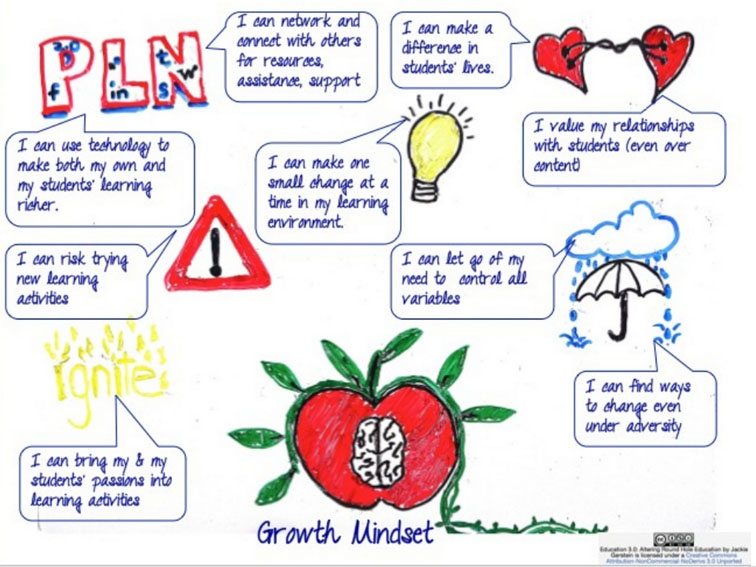
As I was reading through Jackie Gerstein’s Education 3.0: Altering Round Peg in Round Hole Education, several slides stood out to me (one was the focus of a post earlier this week) including the image above, which offers statements teachers can use to both affirm the need for change, and “coach” themselves into a mindset for both change, and hopefully growth. (Number 5 is probably worthy of another post entirely!)
While teachers are constantly admonished to change, there is very little dialogue as to what that kind of change looks like, exactly how to go about making that sort of change in the face of local expectations, and maybe most critically, what kind of “internal coaching” a teacher might start with to establish the kind of thinking position of mindset that promotes fluid change.
You can find Jackie on twitter here, and her (excellent) blog here.

9 Statements Of Affirmation For Teaching (& Coaching) A Growth Mindset
1. I can use technology to make both my own and my students’ learning richer.
2. I can risk trying new learning activities
3. I can bring my and my students’ passions into learning activities.
4. I can make one small change at a time in my learning environment.
5. I can let go of my need to control all variables.
6. I can find ways to change even under adversity.
7. I value my relationships with my students (even over content).
8. I can network and connect with others for resources, assistance, and support.
9. I can make a difference in students’ lives.
Establishing A Growth Mindset As A Teacher: 9 Statements Of Affirmation; image attribution Education 3.0: Altering Round Peg in Round Hole Education from Jackie Gerstein


Technology Tidbits

 
http://www.watchknowlearn.org/-  Tons of videos that can serve as great hooks for your lessons or tutorials for any subject.  The videos can be filtered by subject, topic and even age group. 


News & Notes

Our Seed Fund Proposal has been approved by the Area Superintendent and is moving forward to the next phase of approval.  As a reminder, we are asking for two separate concepts:
 
1.  Improvements to the Science Force Classroom to transform it into more of a STEM lab.  We are also seeking to hire a full time designated facilitator (teacher) who can work together with teachers and students to enhance the core content curriculum with lessons that incorporate a more problem/project based model. Cost: $95K
 
2.  Transformation of our existing Kindergarten through 5th grade classrooms into flexible learning spaces thus fostering a more collaborative classroom environment.  We are in need of furniture that can easily be moved to accommodate group work and that promotes the many different learning styles of elementary students.  Cost: $110K
 
I will keep you posted on the final approval amount for both concepts.  Keep your fingers crossed!
 

Thursday, January 29, 2015

Week of January 29

Thursday Thoughts January 29


I enjoyed meeting with so many teachers today for the mid year reviews.  During the course of the conversations, I kept thinking of how far we have moved out of our comfort zone.  Everyone is working so hard to provide the best instruction possible for ALL learners.  The differentiation in the classrooms is unbelievable and we have come so far with our technology use.  Just think, this time next year, we will have tablets in every classroom (fingers crossed).  I am excited about the great work taking place here.  We continue to be on the MOVE in every way and I am so proud of you.


Staff Spotlight

This week I would like to shine the spotlight on Craig Gendreau.  The 1st grade performance tonight was fantastic.  When the students sang the final song, "Take Me Home Country Road", I had to hold back a tear....seriously I did.  Craig has this remarkable ability to select songs that little people can sing that will just make you feel good.  Not only has he perfected the elementary school performance, but he has stepped up and taken a leadership role with technology at our school.  He applied and has been accepted to serve on the Vanguard Team.  This team, consisting of Craig, Leigh and Tanis, will help lead the charge in personalized learning at our school.  Craig, thank you for bringing down the house at every performance and for your willingness to serve the school in an additional capacity. 


4C's: Collaboration, Communication, Creativity, Critical Thinking Skills


Start Something: 13 Teacher Strategies For Digital Collaboration

by TeachThought Staff 1/08/2015

Teacher collaboration is among the cornerstones of school improvement. When teachers connect–for the right reasons–good things happen.
The ability to connect is increased exponentially through technology. Digital collaboration by teachers has an infinite numbers out possible outcomes, from formal teacher improvement, to informal connecting for people that get you. A global teacher’s lounge, if you will.
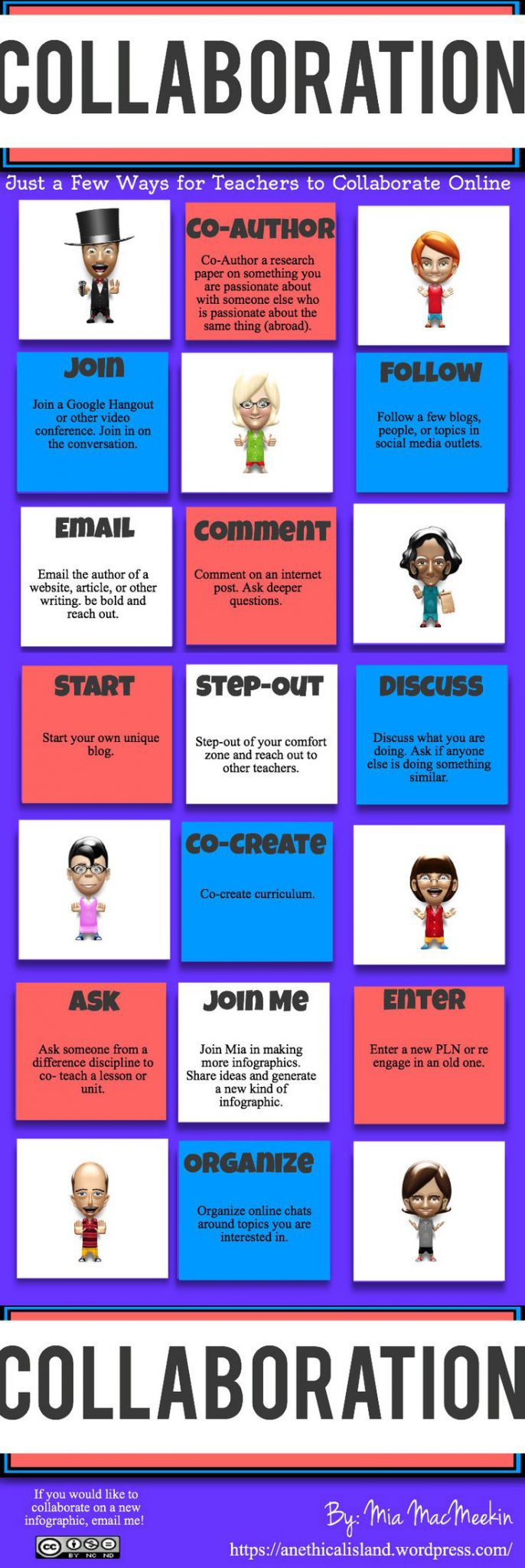
Social media-based professional development is another possible outcome when teachers connect. In contrast to sit-and-get, impersonal training, self-selected and self-directed PD has the potential for just in time, just enough, just for me qualities. The following infographic Mia MacMeekin takes these kinds of ideas and itemizes them, coming up with thirteen strategies for digital collaboration by teachers. She has a few ideas on the graphic, and we’ve added our own below.
Let us know in the comments what strategies you find useful for digital collaboration.
Start Something: 13 Teacher Strategies For Digital Collaboration
1. Co-author a book, blog post, essay, or conference session.
2. Join an edcamp, twitter chat, or blog community (ahem).
3. Follow mentors, colleagues, and inspiring thought leaders on social media.
4. Email someone and ask for help, or thank them for what they do.
5. Comment on an idea that forces you to consider a new perspective.
6. Start something useful and/or fun, local or global, digital or physical.
7. Step out of your comfort zone.
8. Discuss both critical and practical issues around your classroom.
9. Co-create something you’ve long hoped someone else would–an app, a community, a curriculum. Even a PowerPoint or Prezi that clarifies some often misunderstood academic topic.
10. Ask for help, details, resources, or ideas.
11. Join Me–or us. Meet people, connect groups, create potential in education.
12. Enter into new terms with your local school leadership to push for innovation, resources, and better training.
13. Organize your curriculum, your professional learning network, your RSS feed, or even a local event of your own, even if it’s only 4 or 5 colleagues for a book club at Starbucks.

Start Something: 13 Teacher Strategies For Digital Collaboration
teacher-strategies-for-digital-collaboration

Technology Tidbits

http://pbskids.org/designsquad/- Cool site that might serve as a resource for Genius Hour.

News & Notes

For those of you whose children are hardshipped to Fulton County Schools, please note the deadline.

Deadline is Feb. 17 for hardship transfer applications

Parents will use an online form, available through the Student Assignment Office’s website, to enter and submit their information. Hard copy applications are not required this year, with the exception of medical transfers which require pertinent medical provider’s signatures and documentation.
 

Thursday, January 22, 2015

Week of January 22

Thursday Thoughts January 22


I have conducted 30 minute observations in over twenty classrooms within the past two weeks and I can honestly say that being in the classrooms is the best part of my day.  When I walk around your classroom and witness the hard work that you put into the lessons and the love that you have for the students, I truly feel like I am among superheroes.  I don't mean that I see you leaping over tall buildings or moving faster than a speeding train; however I see you juggling 3 or more groups for just about every subject.  I see that you've created countless center activities and games per subject.  I see that even if you are not as tech savvy as you would like, you are trying new things and allowing the kids to lead the way.  I see that you are collaborating and spending hours finding resources, writing lesson plans and assessing students.  You are setting the standard for great teaching and learning!

Staff Spotlight

This week I would like to shine the spotlight on Jennifer Birkmeyer.  As a new teacher, Jennifer has experienced the challenges that come with being a first year teacher.  Jennifer is constantly looking to increase her repertoire of instructional best practices and she is always willing to give 110% to her students.  She has a positive attitude and has truly become a valued member of her 2nd grade team.  In fact, Jennifer has not taken one sick or personal day this school year.   Jennifer, we thank you for what you are doing for students.


4C's: Collaboration, Communication, Creativity, Critical Thinking Skills


Imagination: The Forgotten 21st Century Skill?


www.scholastic.com  By Brian Smithon December 31, 2014


The world changes every day. There is always something new. New technology that we instantly wonder how we ever lived without, video games and 3-D movies that are hyper-realistic, and toys that let kids simulate everything from cooking on the grill to vacuuming.
These things are awesome and I love them all (except maybe for the noise that the play vacuum makes . . . I could live without that and still feel I lead a fulfilled life), but what they are slowly stealing from us is our sense of imagination. I am not the first (and I won’t be the last) to talk about this issue, but instead of just stating the problem, I want to offer a solution.

Not a Box Book Cover
Antoinette Portis wrote a book called Not a Box and, in my humble opinion, it’s a must-have for every classroom. I was once asked what I thought the quintessential read-aloud book for kindergarten would be and (after I looked up the word quintessential to make sure I had the definition correct . . . and I did) I easily chose Not a Box.


Mobile users can view the video here.
Page from Not a BoxThis book is one of the first that I read to my class every year, and one that we revisit several times. The message is clear: use your imagination. The main character, a cleverly drawn rabbit, has a box. An off-page adult asks the rabbit why he’s standing on, beside, and in the box. The rabbit always responds, “It’s not a box.” The words and illustrations are both very simple but they serve as a powerful reminder that during the course of my day I have to allow time for my students to develop their imaginations. I keep this reminder at the front of my room all year.

To help inspire students to use their imagination there are four things that I do:
  1. While the students are working on different projects or learning in our centers, I introduce situations where the solutions aren’t immediately evident by asking¸ “What if . . .?” or “How could . . .?”. These questions help take play to an imaginative level.
  2. When we have an extra five minutes before lunch or some other transition, I will call out an item such as the playground slide and we brainstorm different things it could be. My favorite answer so far is they could lay at the top and the slide could be Rapunzel’s hair.
  3. I give them time and space. I supervise, but I also encourage independence. I’ve found that when students are given time for physical activity that isn’t structured by the teacher, they will find a way to structure it on their own. This is when they can let their imagination take over. Four students and a patch of grass becomes good guys/bad guys, Power Rangers, or a choir that sings our calendar songs in a concert.
  4. Finally, I read other books that talk about imagination such as:

Not a Stick Book Cover
Harold and the Purple Crayon Book CoverAlice the Fairy Book CoverI'm Bored Book CoverStella Star of the Sea Book Cover


It is so easy, especially during the second half of the year, to lose sight of the fact that our students are still children. The end of the year seems so far away to our students (and many of their parents), but every teacher knows that it will be here before we know it. Teachers will soon be judged by what we have taught our students and because of that many will say that there isn’t enough time for “play” in school. I understand that point of view and I feel those pressures too, but when I look at those 21st century skills and how one of the three big areas is critical and creative thinking, I feel like I would doing a disservice by not making time for building imagination.

Technology Tidbits

http://www.kidsciencechallenge.com/#/home- Science games and videos

News & Notes

 The Fulton School Board approved additional instructional funds for each school for the remainder of the school year.  Stay tuned to learn how these funds will be used at Medlock.

In addition, last year you may have heard about the 21st Century media center transformation that took place at Centennial H.S. through their School Goveranance Seed Fund proposal.  The project was so successful, that the Fulton School Board has voted to renovate every FCS high school media center into a similiar model. 

Keep you fingers crossed that our Medlock Bridge Flexible Learning Classroom Seed Fund proposal will be approved.  This could be the start of something big!


Thursday, January 15, 2015

Week of January 15

Thursday Thoughts January 15


I didn't watch the big game on Monday night.  I knew that the Oregon quarterback won the Heisman but I didn't know anything about the Ohio State quarterback, Cardale Jones. In fact, I am not sure that many people knew alot about him prior to Ohio's win over Alabama in the playoff.  But Monday night changed all of that.  Now Cardale Jones is a household name.  The fact that a third string quarterback could garner a win over a team like Oregon is impressive enough, however even more impressive is this young man's mindset shift regarding the importance of his education.  You see just two years ago, he made headlines for the tweet above.  At that time, he was coasting through school and close to being tossed out of college.     But he hung in there and was held accountable for his grades and actions.  The expectations were set and if he wanted to stay at Ohio State, he had to rise to them.  The rest is history.

As educators we have a responsibility to make sure that we don't allow students to coast.  High expectations and holding students accountable will have great results even if we are not present to see them.  I am sure that we have future BCS champions, politicians and even actors sitting in our classrooms.   But before they can fulfill their dreams, we have to make sure that we set the stage for that to happen.
 

Staff Spotlight

This week I would like to shine the spotlight on Janie Massey.  Janie does a remarkable job of working with students who are just below grade level proficiency. She is constantly seeking resources and materials that will help students succeed.  She prepares written progress updates for each of her students in the SST process and has often offered to participate in the meetings to brainstorm additional strategies that can be put in place for the child.  Janie has students that enter and exit EIP throughout the year, yet she never complains about how many students she has to serve without assistance.   Janie not only shares her expertise with homeroom teachers, but she also works directly with the teachers new to Medlock.  We appreciate all that Janie does to support Medlock students as well as teachers. 

4C's: Collaboration, Communication, Creativity, Critical Thinking Skills

Step by Step: Designing Personalized Learning Experiences For Students

     November 28, 2014 
   
The phrase “personalized learning” gets tossed around a lot in education circles. Sometimes it’s used in the context of educational technology tools that offer lessons keyed to the academic level of individual students. Other times it’s referring to the personal touch of a teacher getting to know a student, learning about their interests and tailoring lessons to meet both their needs and their passion areas. As with most education jargon, the phrase isn’t fixed, but it usually connects to the idea that not all students need the same thing at the same time. It implies choice, multiple pathways to learning, many ways to demonstrate competency and resists the notion that all students learn the same way.


Technology Tidbits


ClassResponder - Real Time Student Response System


ClassResponder is a service that provides a nice way for teachers to distribute quizzes to students and gather results as soon as students answer the quiz questions. ClassResponder can be used through your web browser or through their free iPad apps. There is an app for teachers and an app for students. Students don't have to create accounts to participate. Students simply enter your classroom code to join your ClassResponder activities.

ClassResponder offers pre-made quizzes that teachers can use. The quizzes are designed for elementary school students. The pre-made quizzes are aligned to ELA Common Core standards. You don't have to use ClassResponder's pre-made quizzes. You can create your own multiple choice, true/false, and short answer quizzes in your ClassResponder account.

Applications for Education
ClassResponder, like other student response systems, could provide a good way to deliver short review quizzes to your students. You can use the service to make quizzes to use at the end of a lesson to quickly check for your students' understanding of your lesson's main points. You can turn on ClassResponder's instant feedback option for your students so that they don't have to wait until everyone is done before they see their own scores.


News & Notes

I would like to welcome Kris McBride to MBES.  She is an Instructional Technology Coach from the iTeach Center at Kennesaw State University.  Kris will be working closely with our teachers this semester as we embark upon our Personalized Learning journey.  You will see Kris visiting classrooms, meeting with grade levels and providing support in many ways.  Kris is a former teacher and is serving in a support role for our school.  She has multiple schools; however when she is at Medlock, she will have an "office" in the Media Center.  You can reach her anytime via email: McBrideK2@fultonschools.org


Thursday, January 8, 2015

Week of January 8

Thursday Thoughts January 8


I truly needed the time off and relished every moment of it. I enjoyed spending time with extended family and was able to spend quality time with my husband and children.   However, I must say that it felt good to come back this week and connect with my Medlock Family.  By now, you should know me well enough to know that I believe in putting family first.  I enjoy hearing about your family and I thank you for listening to the stories about mine.   But when I refer to the Medlock Family, I am alluding to a genuine bond that has been formed among the staff.  We are more than a group of people who come to work everyday and work with kids.  We are more than just a team.  We are a family.  We celebrate when others are successful.  We hurt when our colleagues hurt.  We share in the ups and downs of this job. We do what we can to lighten each other's load.  The cartoon Lilo and Stitch gives one of the best definitions of family that I can find.  In our Medlock Family, nobody gets left behind or forgotten. 
 

 Staff Spotlight

This week I would like to shine the spotlight on Lindsay Padgett and Jaya Kottamasu.  Lindsay had the great fortune (or misfortune depending on how you look at it) of being my first 30 minute observation.  I want to applaud them for the creativity and instructional best practices that are being implemented in the classroom.  Not only was there alot of music and visual aides during the lesson, but there was also the use of technology and an overall focus on student engagement.  If you don't know, their students can start in the classroom at age three and are eligible to attend due to their special needs.  Our Pre K students don't attend specials and Lindsay's class does not even eat lunch in the cafeteria.  Therefore, Lindsay and Jaya are in the classroom with their students ALL day.   Each afternoon at dismissal, I see Lindsay walk some of her students to the front office to meet the parents where she engages in conversation about their day.  I know that parents can be a bit uneasy about sending their babies to "big kid" school but Lindsay puts their minds at ease.  Many thanks to Lindsay and Jaya for all they do for our youngest Mustangs.
 

4C's: Collaboration, Communication, Creativity, Critical Thinking Skills


The Right & Wrong Way To Use Technology For Learning

, ,
what-do-you-want-kids-to-do-with-technologySo much in learning is subjective, which makes sense because so much in life itself is also subjective, and we learn in order to live. So it’s natural.
Grey areas abound–the usefulness and quality of the Common Core Standards. The importance of curiosity in learning. The evaluation of technology in learning. The utility of letter grades. (And alternatives to letter grades.)
For every educator dead-set on personalizing learning through technology in an outcomes-based K-12 classroom, there is another educator working to develop new learning models that extract the potential of self-directed learning, the role of play in learning, and better understanding the different levels of integration of technology in the learning process itself.
And it’s all good work.
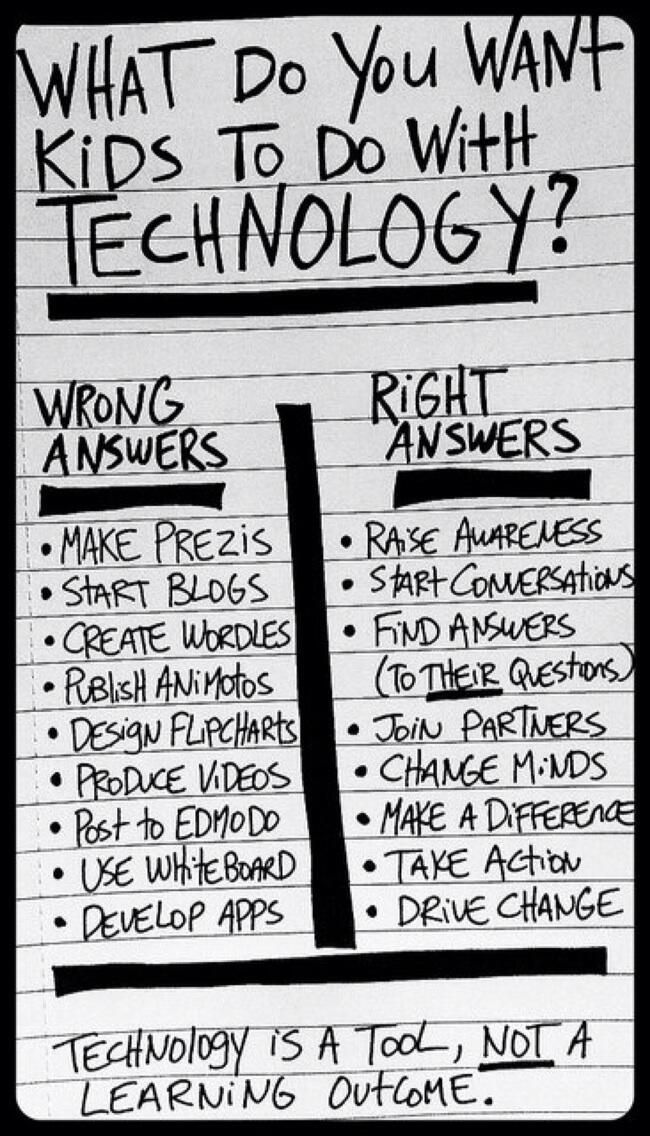
What exactly technology does in learning is also subjective. We’ve offered a clumsy analogy in the past, but sometimes a simple T-chart clarifying “good and bad” is helpful, which is what Bill Ferriter of the wonderful Tempered Radical blog has done with the following image.
The Right & Wrong Way To Use Technology For Learning
Ferriter’s image begins simply enough, with a statement so many of your already believe (based on comments we’ve seen across social media and here on TeachThought as well).
Technology is a tool, not a learning outcome. (Learning is not about technology, mind you.)
But for those that need examples, it goes further, saying no to “developing apps” and “publishing animotos,” and yes to more general functions like “Raising Awareness” and “Starting Conversations.” (Our favorite is helping students find answers to their questions.)
Certainly it’s not true–in our grey area of our own we’re creating here–that creating animoto videos is “wrong” or producing videos is “bad,” but rather that technology should ideally function in pursuit of that awareness and that conversation, not the app or “the animoto.”

Of course you probably already know that, but here’s to clarifying.

 Technology Tidbits

http://www.funenglishgames.com/grammargames.html- good site for additional grammer practice. 

News & Notes

Congratulations Medlock Bridge!  We have been approved to participate in Cohort 1 in the FCS Personalized Learning Process (classroom tablets).  I wish I could say that the tablets will be in our classrooms before the end of the school year, but that does not appear to be the case.  We are starting the process which means that we will be one of the first schools to receive tablets, however there is much work to be done before we get them.  I will keep you posted.