Thursday, January 16, 2014

Week of January 16

Thursday Thoughts January 16


 This week I have enjoyed meeting with teachers to conduct the Mid Year conferences.  During the course of the conversations, I asked about the ways in which you have grown and the areas of challenge this semester.  Repeatedly I hear that being able to satisfy parents and their requests is a challenge.  I thought it most appropriate to share part of an email that I received just yesterday from a parent:
 
"I am constantly amazed at the things my children are learning and doing at school each day. I have been so impressed by each and every one of their teachers, and I cannot imagine my children attending school anywhere else."
 
The work you do is hard. Words of appreciation are far and few between.  But I believe that when you get right down to it, you do what you do because of your love for kids.  You make learning come alive for students and although all parents may not express it, we know that the impact that you have on children will be longlasting.  Thank you for hanging in there through the challenging times and making an impression on some many lives. 


Staff Spotlight:
This week I would like to shine the spotlight on Aronda Carroll.  Aronda's job is very detail oriented and quite important to the operation of our school.  You may not know this, but in her role, mistakes can be costly.  Thankfully Aronda's expertise and attention to detail over the years has kept Medlock in the clear.  I am so thankful to Aronda who does her job with a sense of pride and a spirit of excellence. Thank you for all that you do!

4C's: Collaboration, Communication, Creativity, Critical Thinking Skills

5 Projects That Integrate Art and American History

By Deva Dalporto

Given that they are both humanities subjects, art and social studies fit together quite naturally. Adding an art project to an American history unit can reinforce learning and make class more fun! Here are 5 great projects that integrate art and American history:

  • Design a State Postage Stamp: Have the class create oversized postage stamps of the states. Hand out pieces of poster board cut into large squares and invite the students to fill the whole square with colorful representations of their assigned state. Encourage students to include in their designs defining qualities of their respective states like landmarks, native plants, state birds, etc. See the full instructions here!
  • Presidential Sculptures: To add an artistic twist to a unit on Presidential history, have each student create a clay bust of a U.S. President. You can show them images of historic busts and teach them the history of these sculptures. Once they’ve learned about the historic significance, hand each student a large block of clay and some carving tools and have him or her set to work on a bust of the president of their choice.
  • Life-Size Historical Figures: Have each of your students choose a figure from American history that he or she wants to study. Print out or photocopy a life-size image of the historical figure’s face and have each student create body and appropriate outfit out of construction paper, cardboard, or even real clothing for his or her figure. Hang the finished products up in your classroom and prepare for ooohs and ahhhs from anyone who stops by! See the full instructions here!
  • Build Lincoln’s Log Cabin: Show the students a picture of a typical log cabin from the 1800’s. Hand them each a piece of sturdy construction paper or cardboard for the background, a bunch of pretzel sticks, red construction paper, scissors, and glue.Encourage the students to “build” the cabin by gluing the pretzels onto the construction paper. Have the each cut a roof out of the red construction paper and glue it on. Voila! They have a log cabin!
  • Underground Railroad Quilt: Introduce the concept of the Underground Railroad Quilts. Show the students examples of the quilt code patterns and explain how they were used to help the slaves find their way to freedom. Then, hand each student a 4x4 square of paper and some crayons. Invite students to create their own individual quilt square based on one of the quilt codes. When the students are finished with their individual squares, tape them together to create a large quilt.

Technology Tidbits: (If you have websites to share please email me and I will share with all)

Check out the following website:


http://classroom.jc-schools.net/basic/science.html 

Access to hundreds of science links and resources

http://msnucleus.org/membership/guide/storybooks.html
Free  science animated electronic storybooks (as with anything, PLEASE preview these before showing)

News & Notes

Our proposed 2014-15 school enrollment is 611.  This is a decrease of about 40 students. Individual class size maximums do not appear to be increasing for next year.  As I get more information from the district I will share it with you.


Thursday, January 9, 2014

Week of January 9

Thursday Thoughts  January 9


Two weeks off from work not only gives you time to rest but also gives you time to reflect.  I have a reflection exercise that I do entitled "The Good, the Bad and The Ugly".  This is where I reflect upon events that occurred within a certain time period, a series of decisions that I have made or actions that I took (both proactive and reactive).   The gist of the exercise is that I divide the events, decisions and actions into one of the three categories.  Now you can easily figure what the good and the bad mean, but the ugly is a whole different story.  The items that go in the "ugly" category are those things that I just flat out messed up or situations/decisions where I completely missed the mark.   Although the "good" category makes me feel successful, it is the bad and ugly categories that truly fuel my growth and development as an educator and a leader.   As we bring in the new year, I encourage you to become more reflective on your professional practices and decisions regarding your classroom and students.  Pat yourself on the back for the good and think about the learning opportunities that you can glean from the bad.  As far as the "ugly" just remember that our mistakes are the stepping stones to learning and move forward.  Looking forward to an awesome 2014!!  


Staff Spotlight:
This week I would like to shine the spotlight on Joy Kim.  Joy is a new staff member who is serving in a position that prior to this year had not existed at Medlock.  Joy serves as our Bilingual Community Liaison and needless to say she has had to "build the plane as she flies it".  Joy has jumped right into the mix and reached out to not only Korean parents, but has identified the numerous international families that we have at the school.  Our student body is very diverse representing 17 different countries.  Joy holds monthly parent meetings, translates the school newsletter (Korean) and communicates with individual parents.  She can also work with any teacher who may have a need to reach out to a parent or new student who speaks Korean.  Joy was instrumental in making sure that our Korean Exchange Teachers felt welcome.  I truly appreciate what Joy is doing to make sure that all families within our community have an opportunity to actively participate in their child's education.  Thank you Joy!


4C's: Collaboration, Communication, Creativity, Critical Thinking Skills

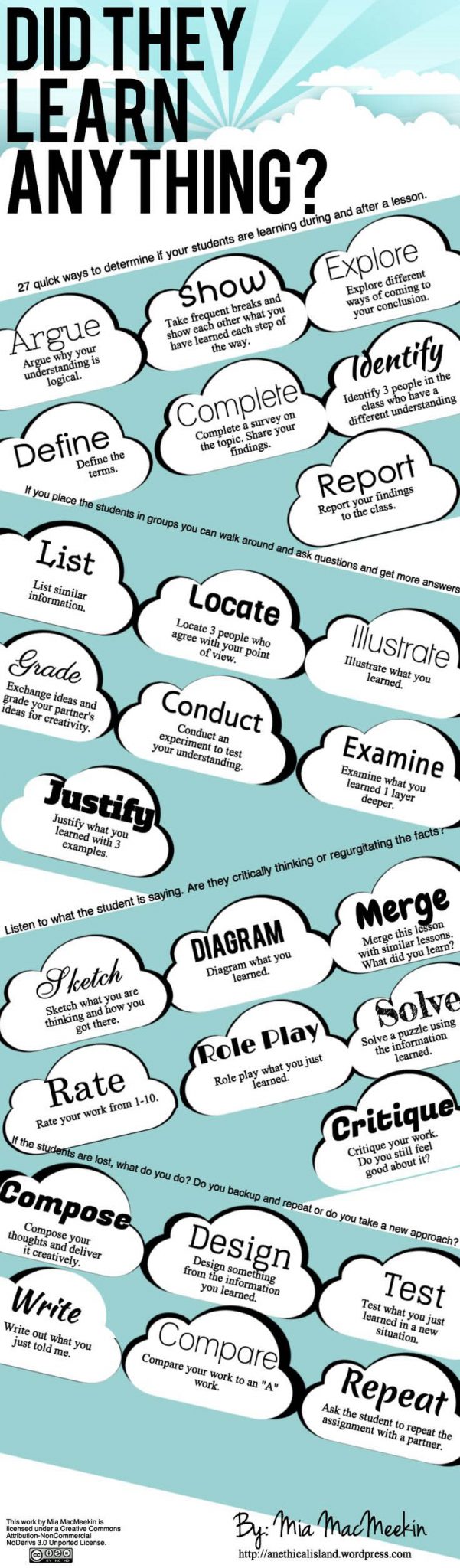
27 Simple Ways To Check For Understanding by Mia MacMeekin


Checking for understanding is the foundation of teaching.
Whether you’re using formative assessment for data to personalize learning within a unit, or more summative data to refine a curriculum map, the ability to quickly and easily check for understanding is a critical part of what you do. (Which was the idea behind our post last March, “10 Assessments You Can Perform In 90 Seconds Or Less.”)
The following infographic Mia MacMeekin offers up 27 additional ways to check for understanding. Some aren’t necessarily quick–”Test what you learned in a new situation”–but there are a dozen or more other ideas that are worth adding to your teacher toolbox, many of which aren’t content-related, but rather cognitively-related (Locate 3 people who agree with your point of view.)
Good stuff.
did-they-learn-anything


Technology Tidbits: (If you have websites to share please email me and I will share with all)

Check out the following website:

http://mathsframe.co.uk/
170 interactive math games for students

http://www.sowashco.k12.mn.us/virtualmedia/elementary/science.htm
This site gives you access to a Minnesota school system's resources.  Hundreds of web resources.
I found that some did not open but you will have to play around with them.


News & Notes
Student hardships are available now.  They are due on Feb 17th.

Teachers please be on the look out for a technology survey that I will be sending out within the next few days.


Thursday, December 19, 2013

Week of December 19

Thursday Thoughts December 19


 One more day! Can you believe it!  I think now is when the panic sets in if you have not started any shopping.  Thank goodness for the concept of gift cards!! 
 
One last organization that I would like to bring to your attention is one that I have volunteered with for the past two years.  The organization is called The Covenant House and it is a short term shelter for youth ages 18-21 who are in immediate need of lodging.  I volunteer there one Saturday per month by preparing a dinner (with my small group) and serving it.  There are definitely a lot of unique young people there who all have a story that will soften the hardest heart.  Many of the youth have aged out of the foster care system, or were living on the street.  Some have families have put them out because of addiction or their alternative lifestyles.  Whatever the case may be, their circumstances  bring them to this facility.  You will never meet a more mannerable and appreciative group of young people.  Of course each month there are a new group of kids so it is very difficult to form any sort of bond with the kids.  The organization takes food donations (money of course) and currently has a Christmas wish list online.  Most of the items are what we would consider basic necessities.  Please check out the website: http://www.covenanthousega.org/
 
It is my most sincere wish that you enjoy the next few weeks and spend it doing exactly what you want to do.  I hope that you will have a safe and prosperous new year.  I thank you for what you do for our students and school community everyday.  Being a part of the Medlock Family is a choice and I thank you for for choosing to be here.  See you next year!!!


Staff Spotlight:
This week I would like to shine the spotlight on Lindsay Padgett.  Lindsay made the choice to come to Medlock from Gwinnett County.  She has been a Special Needs Pre K teacher for several years.  Spend a few minutes in her classroom and you will see why she is so beloved by her students and parents alike.  She has patience beyond measure.  I get so tickled in the mornings at carpool when her students pull up and she is there to greet them.  You should hear the squeals of delight.  Now  imagine working with three year olds daily, several of whom are non verbal.  She and Jaya work with the children to learn basic skills that we take for granted, one being potty training.  Lindsay has steadily increased her class size and will have at least eleven students after the break.  I have not once heard her complain about the class size, the tantrums, the biting (okay maybe she did mention the biting) or the workload that comes with managing IEP goals and objectives for this growing group of little ones.  Lindsay thank you for being a part of the Medlock family.  We appreciate all that you do for our youngest Mustangs!


Thats all folks!!!!!


Thursday, December 12, 2013

Week of December 12

Thursday Thoughts December 12


 Have you ever heard of The Drake House?   It is a temporary shelter for homeless women and children in the North Fulton area.  In 2014, the Drake House will celebrate it's ten year anniversary.  It is actually named after Mary Drake, the woman who helped establish North Fulton Charities.  This housing facility serves approximately 40-50 families per year and each family can stay from 90-120 days.  Programs and life skills classes are provided to the mothers during their stay.  One of the unique things about this organization is that they run two consignment boutiques where all funds benefit the Drake House.  The boutiques, called The Drake Closet, sell new and gently used clothing and jewelry and is completely operated by volunteers.  The stores are located in Roswell (next to the Teaching Museum) and Alpharetta (near the Milton Center).  Below please find the link for the Drake House where you can learn even more information about this facility and the stores.  As you are out and about finishing (or starting)  your shopping, please consider visiting these stores.  Your patronage will definitely benefit a worthy cause.   http://www.thedrakehouse.org/tdh/


Staff Spotlight:
This week I would like to shine the spotlight on Nancy Trenker.  Nancy is not only a key to the success of our Media Center, but we also rely heavily on her for the clinic.  Nancy puts her heart into everything she does for Medlock.  She is in charge of our school inventory (which is not an easy task) and makes sure that our furniture and equipment are accounted for and in the proper place.  Nancy also assists Poonam with computer updates and other technical needs as requested.  I often think about the roles that we all play and how we are interdependent.  Many thanks to you Nancy.  We depend on you.

4C's: Collaboration, Communication, Creativity, Critical Thinking Skills
 

15 Ways Art Can Increase Innovation in Your Science Class  by Erin Macpherson
 

Imagine walking into a science classroom and seeing…paintbrushes? And easels? It may seem strange to those of us who grew up memorizing the periodic table and rolling marbles down inclines, but as the STEM to STEAM movement picks up pace, more and more science teachers are integrating art into their science lessons. Interestingly, the use of art as part of a science curriculum is something that has been done in places like Italy and China for centuries. Mrs. Heather Wallace, a science teacher who has studied in China, told us that she "learned early on that creativity leads to innovation and innovation leads to success in the sciences. Art and science may seem like different disciplines, but when you look at them closely, you see that they are beautifully intertwined."
So how can science teachers integrate art into their every-day curriculum? It takes some work and some ingenuity, but with a little effort, you can give your students a leg up in science by teaching them to think creatively. To get started, here are a few of our favorite creative teaching ideas that integrate the two disciplines.

For Elementary School:
Get your recycling unit going in your Earth science class by making these adorable recycled bottle animals out of recycled materials.
Go on a nature walk and then have your kids recreate the trees they see using paint chips and bark.
Show your kids a basic chemical reaction by making salt watercolor paintings.
Turn your kids into elementary urban planners and let your future engineers plan out their own city and then make a beautiful map to demonstrate what they learned.
Grow your own crystals in class and turn them into crystal rainbows.

For Middle School:
Make magnetic paintings and visually demonstrate to your students how magnetic forces work.
Use marbles and paints to teach students about inclines in your physical science class.
Use baking soda and vinegar to make fizzy color art. Make sure to snap pictures because these masterpieces won't last.
Visualize energy with these fun artistic renderings that use rubber bands, gems, and googly eyes.
Make thaumatropes, images that shift back and forth so quickly that they appear as one. This is a great way to demonstrate changing processes—the exploding of a volcano, the hatching of an egg, or a butterfly emerging from a chrysalis.

For High School:
Make these gorgeous Six Corner Art pictures and get your students thinking about the physical properties of lines, angles, and inclines.
Have your biology students recreate the parts of a cell or the parts of the brain using toothpicks, paint, and other craft supplies.
Study chemical reactions using glow sticks or glow paint.
Bring some action into your physics class with pendulum paintings. Watch out! This one could get messy!
Make spiky crystals by creating a chemical reaction with Epsom salts and hot water.


Technology Tidbits: (If you have websites to share please email me and I will share with all)


Check out the following website:

http://powermylearning.org
A free site (although you have to sign up) that gives you access to thousands of activities.  You can sort through the activities by standard.  Although there are sites for all subjects and grades k-12, the sites for Math and ELA match the common core standards K-8.  I signed up and found myself exploring for over an hour.  I did not even scratch the surface.


News & Notes

A multitude of electronic resources are available to you as educators through the Atlanta-Fulton County Public Library's eCampus program.  As a FCS employee, you are eligible for a free library account.  You can also take online courses for PLU Credit through the eCampus program.  For more information, please read page 13 of the December 10th PL Post.  The library account is also a great way to check out books to load onto your iPad for a two week period.

Thursday, December 5, 2013

Week of December 5

Thursday Thoughts December 5


 Yesterday I had the opportunity to join the 21 other NELC principals at North Fulton Community Charities for our holiday party.  No we didn't actually have the party at NFCC but we served in a volunteer capacity for a couple of hours and then had a potluck lunch back at the Milton Center.  Yes...I brought the soda.  Now this is a new experience for principals, as we are accustomed to grand luncheons at various venues throughout the county.  I can tell you that it was one of the best holiday parties I have ever attended.  We were all assigned different tasks and we worked up a sweat.  My job (with three other principals and Amy Booms) was to sift through donation bags and sort the items into the appropriate bins.  There was plenty of camaraderie, laughter and just plain old fun. 
 
 The NFCC volunteer coordinator shared some facts about the services that they provide to the families in Johns Creek, Alpharetta, Milton and Roswell that truly surprised me.  For example, last year NFCC gave over 1.2 million dollars in rent and utility assistance.  For Thanksgiving this year they gave away turkeys, groceries and gift cards to nearly 800 families in need.  I was so proud that Medlock Bridge donated over 900 pounds to the organization.  For the month of December, I will highlight a few other organizations in the blog that do great work to assist those in need.  If you have a chance, please read all about the work that the NFCC does at http://nfcchelp.org/.   In additon, I have provided a link below to the pictures of the principals hard at work yesterday.  Here at Medlock we have a great opportunity to assist a few of our own students this season.  Thank you in advance for participating in our gift card campaign.   It will mean the world to the recipients.


Staff Spotlight:
This week I would like to shine the spotlight on Traci Fleck.  Traci has a passion for teaching and a huge heart for her students.  She serves as an advocate for her students' needs and rarely takes no for an answer.  Traci seeks opportunities for professional growth and I am excited to announce that she is days away from graduating from Georgia State.  She works closely with her students' parents and goes above and beyond when it comes to communication.  Traci thank you for doing what it takes to educate and inspire your students.

4C's: Collaboration, Communication, Creativity, Critical Thinking Skills

5 Hallmarks of a Creative Project


Structure student projects to demand creativity
 
By Melinda Kolk
 
Why is it that we definitely know a creative project when we see it, but we are hesitant to assess creativity, fearing that it is too squishy or subjective?

Creative projects are the tangible products of creative behavior and creative thinking. If we want students to produce creative works, we need to structure student work so that the outcome is a natural result of these behaviors.

A project is creative when it:
1. Asks, or attempts to answer, the right kind of questions
A project that answers a question with an obvious right answer doesn’t leave much room for creative thinking. Create is at the very top of Bloom’s taxonomy. A project’s questions should prompt students to: integrate, design, invent, compose, organize, plan, propose, and of course, create.
We are probably all familiar with the concept of essential questions, questions “that pose dilemmas, subvert obvious or canonical truths, or force incongruities upon our attention.” (Bruner, 1996). Even if the project doesn’t drive to an essential question, it should be framed by a question that is open-ended, eliminating the expectation that the project requirements can be fulfilled by a specific answer or type of answer.
Read more about Bloom’s and creative project work here.
Most importantly, questions must be meaningful. Questions that can be answered with factual information are useful, but not meaningful. Such questions may be part of gathering foundational knowledge, but the crux of student work should address questions that connect students to the world beyond the classroom. That doesn’t mean that students have to have free rein to do whatever they want, but they do need to feel that their work is recognized and has an impact.

2. Requires collaboration or cooperation
There is no shortage of research that shows that creativity does not thrive in competition. While individual work can certainly be creative, team work leads to more creativity for more students.

Collaborating exposes us to different perspectives and leads to more diverse and varied ideas, especially when the group is heterogeneous. If group norms are such that all ideas are welcome and debate is free and respectful, ideas cross-pollinate and produce better and more original thinking.

Even if a project is more cooperative than collaborative and students work to make an individual contribution to a larger whole-class project, try to work in opportunities for students to collaborate on brainstorming, planning, and evaluating. These activities expose individuals to a more diverse range of ideas and perspectives, allowing them to incorporate those concepts into their personal work.
3. Doesn’t need the student’s name on it
That’s right. If you can’t tell the difference between students’ work, the project didn’t leave enough room for students to invest themselves. No worksheet is creative. Projects that are creative are as unique as the students that create them.

In a student-created version of Judi Barrett’s Things That are Most in the World, there is an amazing range of content, intonation, and style. Although the student names appear at the bottom of each page, I’m certain that neither the teacher nor the parents needed to see them to identify each student’s work.

Creative work is deeply original, making it also deeply personal. If students can’t see themselves in their work, why would they want do it? In her research on creativity, and in exploring other research on creativity, Teresa Amabile found that intrinsic motivation is conducive to creativity and extrinsic motivation is almost always detrimental. Be sure to give students “voice and choice” so they can appropriate the task to their interests and skills to make the work more interesting and satisfying.

4. Includes original art or design
Remember your students’ first PowerPoint? When they spent what felt like a week designing the title page and finding just the right font, Word Art. or animation? Most kids get over that by their fifth project. Do they stop because they are truly getting better at the process or because we have crushed their creativity? If we keep outlining requirements (on page 1, include x and y) or scaffolding projects through research worksheets, creative projects quickly turn boring, and we end up watching variations of the same PowerPoint presentation 24 times.

If you ask a room full of Kindergartners who can draw a frog, you will see lots of raised hands. Ask that same question in middle school and you probably won’t get one… unless you have an “accomplished” artist in the class.

Why is this? Since most of us aren’t great at drawing, our original artwork isn’t likely to garnish praise and admiration. As we get older, we are less and less likely to try drawing something new for fear that our art will be labeled “not good.” We are conditioned over the years to take fewer and fewer risks.

But creativity requires risk taking, as Sir Ken Robinson explains, “If you’re not prepared to be wrong, you’ll never come up with anything original.” Asking all students to draw their own work creates a culture of risk taking. If everyone has to do it, everyone is in the struggle together. Just be sure to follow it up with a celebration of effort and risk taking… do not just focus on the quality of their drawings.

If you aren’t ready for this step or don’t want to take the time necessary for original illustration, ban the use of clip art or make require justification for any clip art used in a project. You could also require students to edit the clip art or synthesize multiple pieces of clip art into a new design. Stop using templates, or at the very least, require students to make changes to the templates.
5. Transfers energy and demonstrates passion
In addition to new inventions and products of value, creativity brings joy to our world. Creative projects often make us smile, whether we are in the audience or in the creator’s seat. We work hard on creative projects because they are meaningful and important to us.

Creative projects portray the fun and energy that went into them and transfer this energy from the creator to the viewer. In the same way a passionate presenter inspires us and connects us to content in a way no lukewarm presenter can, you can easily tell when students have connected with the content and approached it in ways that reflect their passions and interests.
The hard work of creativity
Making creativity a requirement for your learning projects isn’t just about fun. When we take a creative approach, our students are free to try new things and explore passions.

But creativity isn’t easy, it’s the result of hard work!
Hard work building adequate content knowledge to be capable of transformative ideas and products.

Hard work creating original infographics to display data in more revealing ways.

Hard work drawing and designing original artwork to model our ideas or connect with our audience.

Hard work looking at ideas from multiple perspectives, especially those that contradict our own.

Hard work doing thinking that isn’t just remembering, but is connecting, synthesizing, and transforming.

Hard work imagining what could be instead of using or thinking about what already is.

Hard work bringing the novel into existence and getting others to value what is new and different.
It’s time to get down to some hard work!

Technology Tidbits: (If you have websites to share please email me and I will share with all)


Check out the following websites:

http://interactivesites.weebly.com/science.html-
This site is a great resource to locate additional interactive sites for all subjects

http://www.uen.org/3-6interactives/science.shtml
Science resources provided by the state of Utah

News & Notes

If you have a high school senior or know someone who does, please note the following:

The North Fulton Council of PTAs (NFCPTA) has posted the 2014 Sally FitzGerald Scholarship application online please visit the website at http://www.nfcpta.com/?page_id=696

The Sally FitzGerald Scholarship is open to all seniors graduating from a North Fulton County High School. This scholarship targets students who exhibit characteristics in volunteerism, extra-curricular activities, academic excellence, and essay writing. The deadline for this scholarship application is March 19th, 2014. The scholarship application package must be mailed and have a postmark no later than this date to be considered.


Thursday, November 14, 2013

Week of November 14

Thursday Thoughts November 14


I have waited all week to share the most amazing true story with everyone! As I was walking to my car last Friday (around 6:15pm) I saw a car pull into one of the parking spaces in front of the school.
A woman got out of the car and it was obvious that she had been crying.  I thought that she was picking up a child from Primetime and was possibly running late.  I asked if I could help her and she stated, "I used to attend this school".  Although I really needed to get home, I was worried that she  was in some sort of trouble or pain.  I introduced myself and invited her to come in and look around.  She shared how she had attended Medlock from 2nd to 5th grade and she began naming teachers.  Most of the teachers she named are been long gone but I took her to the kiosk to look at pictures of the current staff.  As she looked at the pictures, she began to share with me how much the school meant to her and that her fondest memories of childhood were associated with Medlock Bridge.  She remembered Judy Zollman and wanted to know if Mrs. Doyle, her favorite teacher, was still teaching.  I told her that Debbie works with students and teachers now and we watched the photos on the kiosk until we got to Debbie's pictures.  This brought the biggest smile to her face.  As we talked, she shared that she moved to North Carolina after 5th grade and never really got to come back.  This particular weekend she was in Atlanta for a work related conference and decided to visit her old elementary school.  She thought things looked just as she remembered and although we didn't tour the building (it was getting late) we did visit the media center.  By the time she finished reminiscing, Retta Hunter, age 29, was no longer crying and was so thankful to get the chance to come back to a place that holds such a special place in her heart. 

We may never know the impact that we have on children's lives.  The time they have with us may create memories that will last a lifetime.  I hope that twenty years down the road (when most of us are enjoying retirement) some child will return as an adult and reminisnce about his/her time here at Medlock.  What you do matters....don't ever forget it.


Staff Spotlight:
This week I would like to shine the spotlight on Craig Gendreau.  Mr. Gendreau makes music come alive for students.  From the welcoming music he plays on the guitar as students arrive to class to the soulful grade level musical performances(which put big smiles on many faces), Craig is truly dedicated to his craft.  Craig is a team player and does not hesitate to pitch in and assist wherever and whenever needed.  You can find him each Monday and Thursday after school with the chorus and steele drum band students respectively.  Medlock students are fortunate to have a teacher like Mr. Gendreau who offers all students an opportunity to be "rock stars".  Craig, thank you for the work you do with students everyday.
4C's: Collaboration, Communication, Creativity, Critical Thinking Skills

11 Ways to be an Inquiry-based Teacher

Posted by on May 8, 2013
 
It’s hard to run an inquiry-based classroom. Don’t go into this teaching style thinking all you do is ask questions and observe answers. You have to listen with all of your senses, pause and respond to what you heard (not what you wanted to hear), keep your eye on the Big Ideas as you facilitate learning, value everyone’s contribution, be aware of the energy of the class and step in when needed, step aside when required. You aren’t a Teacher, rather a guide. You and the class find your way from question to knowledge together. 

Because everyone learns differently.

You don’t use a textbook. Sure, it’s a map, showing you how to get from here to there, but that’s the problem. It dictates how to get ‘there’. For an inquiry-based classroom, you may know where you’re going, but not quite how you’ll get there and that’s a good thing. You are no longer your mother’s teacher who stood in front of rows of students and pointed to the blackboard. You operate well outside your teaching comfort zone as you try out the flipped classroom and the gamification of education and are thrilled with the results.
And then there’s the issue of assessment. What your students have accomplished can’t neatly be summed up by a multiple choice test. When you review what you thought would assess learning (back when you designed the unit), none measure the organic conversations the class had about deep subjects, the risk-taking they engaged in to arrive at answers, the authentic knowledge transfer that popped up independently of your class time. You realize you must open your mind to learning that occurred that you never taught–never saw coming in the weeks you stood amongst your students guiding their education.
Let me digress. I visited the Soviet Union (back when it was one nation) and dropped in on a classroom where students were inculcated with how things must be done. It was a polite, respectful, ordered experience, but without cerebral energy, replete of enthusiasm for the joy of learning, and lacking the wow factor of students independently figuring out how to do something. Seeing the end of that powerful nation, I arrived at different conclusions than the politicians and the economists. I saw a nation starved to death for creativity. Without that ethereal trait, learning didn’t transfer. Without transfer, life required increasingly more scaffolding and prompting until it collapsed in on itself like a hollowed out orange.

So how do you create the inquiry-based classroom? Here’s advice from a few of my efriend teachers:
  1. ask open-ended questions and be open-minded about conclusions
  2. provide hands-on experiences
  3. use groups to foster learning
  4. encourage self-paced learning. Be open to the student who learns less but deeper as much as the student who learns a wider breadth
  5. differentiate instruction. Everyone learns in their own way
  6. look for evidence of learning in unusual places. It may be from the child with his/her hand up, but it may also be from the learner who teaches mom how to use email
  7. understand ‘assessment’ comes in many shapes. It may be a summative quiz, a formative simulation, a rubric, or a game that requires knowledge to succeed. It may be anecdotal or peer-to-peer. Whatever approach shows students are transferring knowledge from your classroom to life is a legitimate assessment
  8. be flexible. Class won’t always (probably never) go as your mind’s eye saw it. That’s OK. Learn with students. Observe their progress and adapt to their path.
  9. give up the idea that teaching requires control. . Refer to #8–Be flexible
  10. facilitate student learning in a way that works for them. Trust that they will come up with the questions required to reach the Big Ideas
In the end, know that inquiry-based teaching is not about learning for the moment. You’re creating life-long learners, the individuals who will solve the world’s problems in ten years. How do you ensure they are ready?


Technology Tidbits: (If you have websites to share please email me and I will share with all)


Check out the following websites:

www.arcademicskillbuilders.com/  A site with learning through the use of multi-player games. 
 (A large selection of free games)


www.cookie.com/ A great site for educational games and teacher resources.


News & Notes
GA DOT to hold Parsons Road Detour Open House Nov. 21; 5-7pm
On November 21, 2013 at Taylor Lodge at St. Benedict Catholic Church 11045 Parsons Rd, Johns Creek, GA 30097 the Georgia Department of Transportation will hold a detour open house concerning a proposal to replace an existing bridge (ID. # 121-5022-0) on Parsons Road over Johns Creek located in the City of Johns Creek.  Go to Parsons Road Detour Open House for more information.

GA 400 toll collection will end after the evening rush hour on Friday, November 22, weather permitting. Even though the GA 400 tolls are ending, be sure to keep your Peach Pass for use when you need to bypass traffic using the existing I-85 Express Lanes, or the planned I-75 Express Lanes south of Atlanta (coming in 2016); and I-75/575 Express Lanes in the Northwest Corridor (coming in 2018). However, if you do decide to close your account, your full balance, including any automatic replenishments, will be refunded.


Thursday, November 7, 2013

Week of November 7

Thursday Thoughts November 7


This week I have really been thinking about the concept of "fair" especially as it relates to education.  Often times educators will hesitate in providing a special treat or reward for a student because it would be unfair to the other children who won't get the reward.  In fact, when we have to accomodate some children in ways that the others do not require, that may seem unfair.  I have been reflecting on this simple truth:  children come to school with all sorts of life circumstances that aren't fair.  Whether it is a disability, home situation or behaviors that they are ill equipped to control, children are dealing with the hand that they have been dealt and it is unfair.  As adults, we know that life isn't fair.  I think that is why we try so hard to make things fair for our students.  Maybe instead of focusing on making everything fair, we can focus on leveling the playing field for all students.  Thank you for making sure that all students are supported in many different ways so that they can be successful and prepared for a world that is unfair.


Staff Spotlight:
This week I would like to shine the spotlight on Janie Massey.  Many of us have students that we send to Janie to "catch up". I marvel at how Janie can work with a child and get him/her on grade level in a matter of months. Janie uses a variety of strategies to help ignite students' passion for reading AND increase their ability to read proficiently.  Janie also works with teachers to provide strategies that are helpful in the classroom.  Not only does Janie work with students in grades K-5 but she also works with teachers in the New Teacher Mentor Program.  Janie spearheads this program and checks in with the mentors to provide support that can then be passed along to new teachers.  I appreciate Janie for her passion for teaching and learning and her dedication to supporting our struggling learners and new teachers.

4C's: Collaboration, Communication, Creativity, Critical Thinking Skills

The Inquiry Process Explained Visually for Teachers

www.educatorstechnology.com

 Learning is all about being curious and inquisitive. It is a process in which learners explore the unknown through their senses using both sensory and motor skills. Being involved and engaged in the learning task is the key to a successful learning journey and to elicit this kind of engagement from learners, teachers need to nurture a learning environment where students take responsibility for their learning and 'where they are only shown where to look but not told what to see'. Such environment definitely requires a solid approach and an informed strategy to learning one that is dubbed: inquiry-based learning.

Inquiry-based learning is essential in developing the most solicited 21st century skills : problem solving and critical thinking.As a teacher, you might be wondering about ways to inculcate the precepts of strategy into your teaching and lesson planning. Here is for you a an excellent visual about the inquiry process created by educators from Australia and which I discovered through Mindshift.

inquiry process

Technology Tidbits: (If you have websites to share please email me and I will share with all)


Check out the following website:


Great for creative hands on science and social studies activities
http://www.stemcollaborative.org/
STEM interactive activities for upper grades (Resources tab has ideas for lower grades)

News & Notes
 Open enrollment ends tomorrow November 8.   All your enrollment elections must be complete no later than 5:00pm.